


Whether you are planning a safari in South Africa, a hunting expedition, or simply want to learn about these magnificent creatures, this guide covers everything you need to know — from each animal’s behaviour and habitat, to where you can see them, their conservation status, and the role of ethical hunting in protecting their future.
Why Are They Called the Big Five?
The name has nothing to do with physical size. It was born from the experience of 19th-century hunters who walked the African bush on foot — before vehicles, GPS, or high-powered optics. These five animals earned the title because they were the most dangerous to track, the most unpredictable when cornered, and the most likely to turn the hunt around on the hunter.
A wounded Cape buffalo will circle back through thick brush and ambush its pursuer. A leopard, nearly invisible in dappled shade, can cover six metres in a single leap. An elephant moves through dense bush in near-silence despite weighing over six tonnes. A rhinoceros charges at speeds up to 55 km/h with poor eyesight but devastating accuracy. And a lion, the apex social predator, can attack from multiple angles in a coordinated pride.
The danger and skill required to hunt these five animals set them apart from all other African game — and the name has endured for over a century.
The Five Animals
African Lion (Panthera leo)
The African lion is the second largest cat in the world, with males weighing between 190 and 225 kg and standing roughly 1.2 metres at the shoulder. Unlike other big cats, lions are social animals. They live in groups called prides, typically consisting of two to three males, several females, and their young.
Lions are the only cats with a visible difference between males and females — the male’s mane serves as both a display of fitness and protection during fights. A lion’s roar can be heard up to 8 km away and is used to communicate territory boundaries and locate pride members across vast distances.
In South Africa, the lion population is estimated at approximately 3,000 individuals. Kruger National Park alone is home to an estimated 1,600 to 1,800 lions, though recent studies suggest a decline in the northern regions of the park.
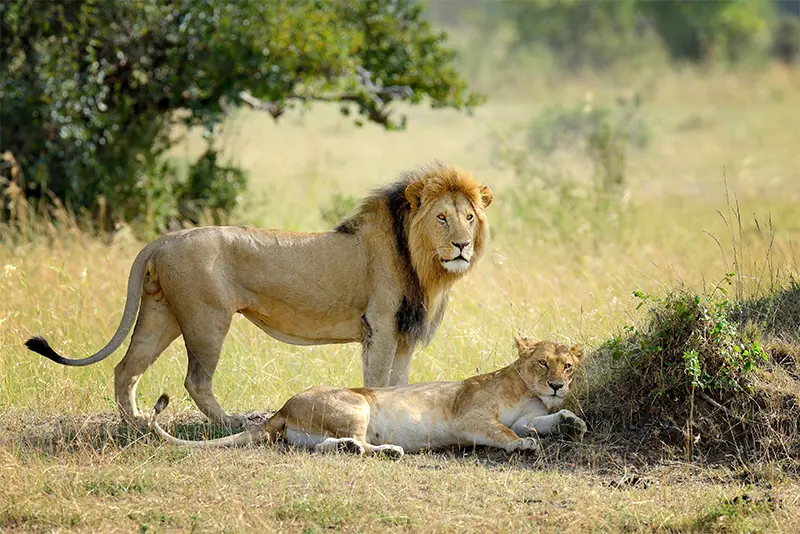
Habitat: Savanna grasslands, open woodlands, and semi-arid regions. Lions prefer areas with good cover for stalking prey and access to water.
Diet: Primarily large ungulates — wildebeest, zebra, buffalo, and various antelope species. Lions are opportunistic and will scavenge when the opportunity arises.
Best viewing: Central Kruger (Satara rest camp area), known as “Big Cat Country,” offers the highest concentration of lion sightings. The Sabi Sands private reserve is equally renowned.
African Leopard (Panthera pardus)
The leopard is Africa’s most elusive big cat. Solitary, nocturnal, and extraordinarily adaptable, leopards inhabit environments ranging from tropical forests and mountain ranges to semi-desert scrubland. They are the most widely distributed of all African big cats, yet the hardest to spot.
A leopard can leap up to 6 metres horizontally and 3 metres vertically. They routinely haul prey weighing more than their own body weight up into trees to protect it from scavengers — a feat of strength unmatched by any other cat. Males weigh between 60 and 90 kg, females between 30 and 60 kg.

South Africa hosts the largest leopard population in Africa. However, the Department of Environmental Affairs banned leopard hunting across the entire country in 2016, and there are currently no plans to reopen the season.
Habitat: Remarkably adaptable — rocky outcrops, dense bush, riverine forests, and even suburban fringes. Leopards are found across nearly every province in South Africa.
Diet: Small to medium-sized prey including impala, duiker, bushbuck, and smaller mammals. They are also known to take baboons, porcupines, and birds.
Best viewing: Sabi Sands has the highest concentration of habituated leopards in the world. Night drives in private reserves offer the best chance to see these nocturnal hunters. The Londolozi and MalaMala reserves are particularly famous for leopard sightings.
African Elephant (Loxodonta africana)
The African bush elephant is the largest living land animal. Adult males can stand over 3.3 metres at the shoulder and weigh between 5,000 and 6,800 kg. Their ears alone can measure 2 metres by 1.2 metres and weigh up to 20 kg each — used not only for hearing but as radiators to regulate body temperature.
Elephants are highly intelligent, social animals with complex family structures led by a matriarch. They demonstrate grief, use tools, recognise themselves in mirrors, and have been observed performing ritual behaviour around the remains of deceased family members. Their memory is legendary — elephants can remember water sources, migration routes, and individual humans for decades.
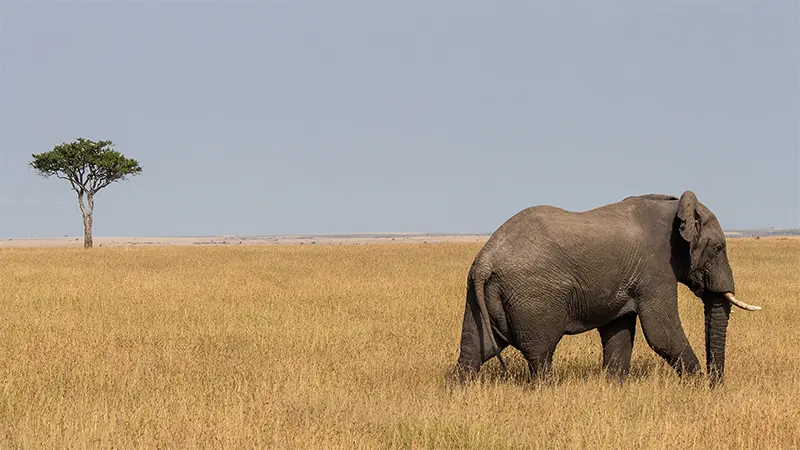
South Africa’s elephant population is approximately 44,000, with Kruger National Park home to an estimated 31,500 — one of the largest managed elephant populations in Africa. Addo Elephant National Park in the Eastern Cape is another significant stronghold with over 600 elephants in a malaria-free environment.
Habitat: Savanna, bushveld, and woodland. Elephants require large home ranges and access to permanent water. They are ecosystem engineers — their feeding habits create pathways and clearings that benefit countless other species.
Diet: Herbivorous — consuming up to 150 kg of vegetation and 200 litres of water daily. They feed on grasses, bark, roots, leaves, and fruit.
Best viewing: Southern Kruger (Lower Sabie), Addo Elephant National Park, and Tembe Elephant Park in northern KwaZulu-Natal.
Rhinoceros (White and Black)
South Africa is the global leader in rhinoceros conservation, holding approximately two-thirds of Africa’s remaining rhinos. Two species are found here: the southern white rhinoceros (Ceratotherium simum simum) and the black rhinoceros (Diceros bicornis).
Despite their names, both species are grey. The “white” in white rhino is believed to derive from the Dutch word “wijd” (wide), referring to the animal’s broad, square lip adapted for grazing. The black rhino has a pointed, prehensile upper lip suited for browsing leaves and twigs.
White rhinos are the larger of the two, with males weighing up to 2,300 kg. They are relatively docile grazers that live in groups called crashes. Black rhinos are smaller (up to 1,400 kg), more solitary, and significantly more aggressive — they are known to charge without provocation and can reach speeds of 55 km/h.
Population estimates place approximately 12,968 southern white rhinos and 2,056 black rhinos in South Africa. The black rhino is classified as Critically Endangered by the IUCN, while the white rhino is Near Threatened. Poaching remains the most severe threat — between 2007 and 2023, South Africa lost over 10,000 rhinos to poaching.
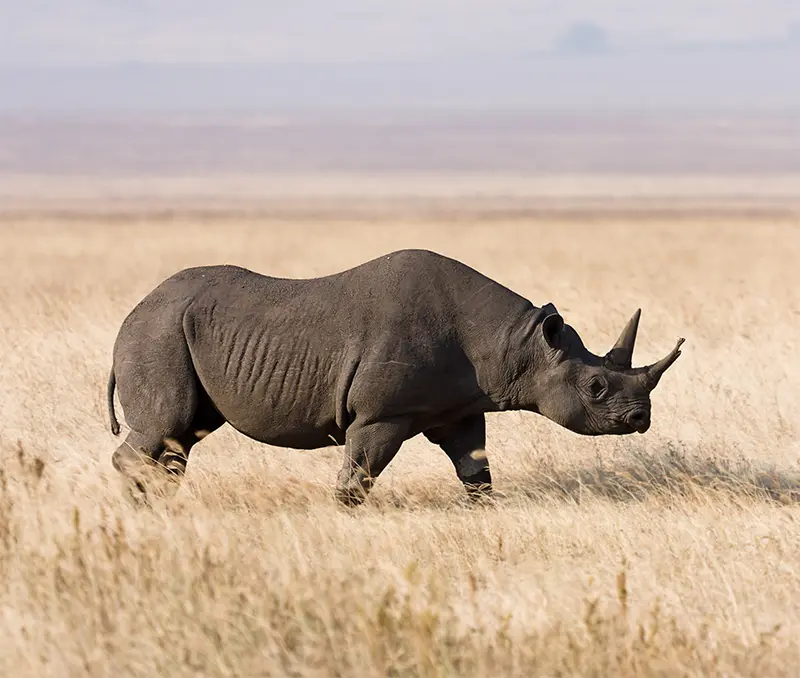
Habitat: White rhinos prefer open grassland and savanna. Black rhinos favour dense bush, thickets, and woodland edges.
Best viewing: Hluhluwe-iMfolozi Park (the birthplace of rhino conservation), Kruger National Park, and Pilanesberg Game Reserve. iMfolozi’s “Operation Rhino” in the 1960s saved the white rhino from extinction when the population had fallen to fewer than 50 individuals.
Cape Buffalo (Syncerus caffer)
The Cape buffalo is arguably the most dangerous of the Big Five and the one most accessible to hunters today. Known as “the Black Death” or “widowmaker” among experienced hunters, a wounded buffalo is considered the most dangerous animal in Africa. They are responsible for more hunter fatalities than any other large game species.
Adult bulls weigh between 700 and 900 kg and carry massive curved horns that fuse at the base to form a bony shield called a “boss” — capable of stopping a rifle bullet. Buffalo are herd animals, with groups ranging from a few dozen to several thousand. When threatened, the herd forms a defensive wall with calves in the centre. Old bulls, known as “dagga boys” after the mud they wallow in, live alone or in small bachelor groups and are particularly unpredictable.
South Africa has an estimated 30,000 savanna buffalo. Unlike the other members of the Big Five, the Cape buffalo is classified as Least Concern by the IUCN, making it the most commonly hunted of the five. Buffalo hunting in South Africa is legal and regulated, requiring a minimum caliber of .375 and the presence of an experienced Professional Hunter (PH).
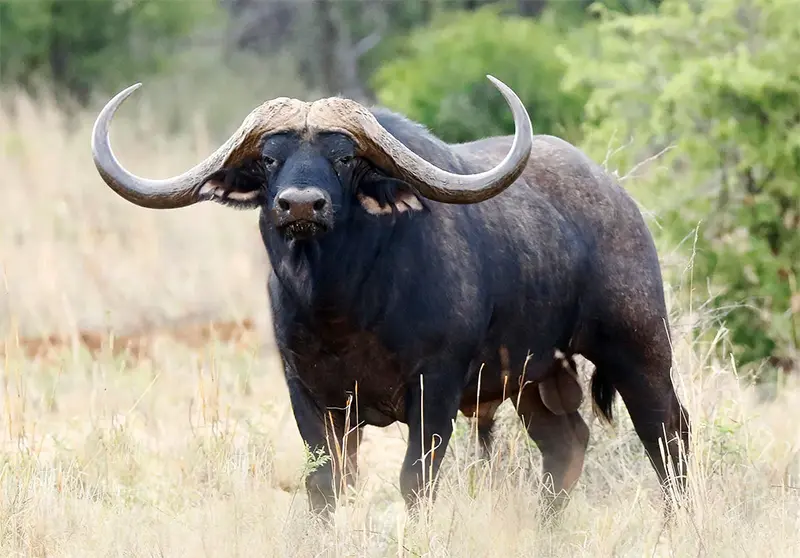
Habitat: Savanna, woodland, and floodplains. Buffalo are never far from water and prefer areas with tall grass for cover.
Diet: Grazers — primarily tall, coarse grasses. Buffalo feed mainly at night and rest during the heat of the day.
Best viewing: Lower Sabie and Satara areas of Kruger National Park, Hluhluwe-iMfolozi, and Addo Elephant National Park.
Where to See the Big Five in South Africa
South Africa offers some of the most accessible Big Five viewing in the entire continent. Here are the top destinations:
Kruger National Park
Nearly 2 million hectares of wild bushveld, Kruger is the flagship destination for Big Five viewing in South Africa. It is significantly more affordable than private reserves and offers self-drive options. Southern Kruger (Lower Sabie, Crocodile Bridge) is best for first-time visitors, while central Kruger (Satara) is renowned for predator sightings. Book accommodation at least six months in advance for peak season (June–October).
Sabi Sands Private Game Reserve
Adjacent to Kruger with no fences between them, Sabi Sands covers 65,000 hectares and boasts the highest concentration of big cats in Africa. This is the premier destination for leopard sightings. Guided drives, walking safaris, and exclusive lodges make it the luxury Big Five experience.
Hluhluwe-iMfolozi Park
The oldest proclaimed game reserve in Africa (1895), located in KwaZulu-Natal. This is where the white rhino was saved from extinction and remains one of the best places to see both black and white rhinos in the wild. It is malaria-free and easily accessible.
Addo Elephant National Park
Located in the Eastern Cape, Addo was established in 1931 to protect the last 11 elephants in the region. Today it is home to over 600 elephants plus lion, buffalo, black rhino, and leopard. Malaria-free, family-friendly, and less crowded than Kruger.
Pilanesberg Game Reserve
Only two hours from Johannesburg in a collapsed volcanic crater, Pilanesberg is malaria-free and home to all Big Five species. Its proximity to Sun City makes it a popular choice for visitors combining safari with other activities.
Hunting the Big Five
Hunting the Big Five was once considered the ultimate test of skill and courage for a hunter in Africa. Today, only the Cape buffalo can be legally hunted in South Africa without exceptional permits. The regulations reflect both conservation priorities and the evolving relationship between humans and these animals.
Cape Buffalo — Huntable
The Cape buffalo is the only member of the Big Five that can be freely hunted in South Africa (with proper permits and a Professional Hunter). Trophy fees typically start around $12,000–$16,000, and packages often combine buffalo with plains game species. A minimum caliber of .375 is required by law. Read our detailed Cape Buffalo hunting guide for more information.
Leopard — Closed Season
South Africa closed the leopard hunting season nationwide in 2016. There are currently no plans to reopen it.
Elephant — Restricted
Elephant hunting is highly restricted and only available through special permits on specific private game reserves. The costs typically exceed $40,000–$80,000 for a bull elephant.
Rhinoceros — Extremely Limited
Rhino hunting permits are among the rarest and most expensive in Africa. Only a handful of permits are issued annually for white rhino bulls, with trophy fees exceeding $125,000. Black rhino hunting is virtually non-existent. All rhino hunts require extensive permitting and government oversight.
Lion — Restricted
Wild lion hunting in South Africa is limited to specific concessions in Limpopo Province. Regulations prohibit hunting pride lions and require a minimum age for trophy animals. Trophy fees range from $30,000 to $50,000+.
For hunters seeking accessible Big Five-caliber hunting in South Africa, the Cape buffalo combined with plains game species offers the most realistic and rewarding experience. Contact us to discuss a hunting package.
Conservation Status
Four of the five species are listed as threatened by the IUCN:
| Species | IUCN Status | Estimated SA Population | Primary Threat |
|---|---|---|---|
| African Lion | Vulnerable | ~3,000 | Habitat loss, human-wildlife conflict |
| African Leopard | Vulnerable | Largest in Africa | Habitat fragmentation, persecution |
| African Elephant | Vulnerable | ~44,000 | Habitat loss, poaching for ivory |
| White Rhinoceros | Near Threatened | ~12,968 | Poaching for horn |
| Black Rhinoceros | Critically Endangered | ~2,056 | Poaching for horn |
| Cape Buffalo | Least Concern | ~30,000 | Disease (bovine tuberculosis) |
South Africa plays a disproportionately important role in Big Five conservation. The country holds approximately 80% of the world’s white rhinos, one of Africa’s largest elephant populations under active management, and the continent’s largest leopard population. Conservation efforts — including anti-poaching units, community-based programs, breeding initiatives, and well-regulated hunting — have kept populations stable or growing for most species.
The story of Hluhluwe-iMfolozi’s white rhino is perhaps the greatest conservation success in African history. When the Operation Rhino program began in the 1960s, fewer than 50 southern white rhinos remained worldwide. Today, the population exceeds 15,000 — saved entirely through South African conservation efforts.
Beyond the Big Five
South Africa’s wildlife extends far beyond the famous five. Safari guides have created additional groupings to highlight the incredible biodiversity found across the country:
The Little Five: Named as smaller counterparts to the Big Five — the ant lion, leopard tortoise, elephant shrew, rhinoceros beetle, and buffalo weaver. These tiny creatures require patience and a keen eye to spot, making them a rewarding challenge for nature enthusiasts.
The Ugly Five: The hyena, wildebeest, vulture, warthog, and marabou stork — animals that may lack conventional beauty but play critical roles in their ecosystems.
The Shy Five: The porcupine, bat-eared fox, aardvark, meerkat, and aardwolf — nocturnal or elusive animals rarely seen on standard game drives.
At Gaspare Spanio Safaris, our safari activities give you the opportunity to experience South Africa’s extraordinary wildlife beyond the Big Five, including many of the huntable plains game species that make the country a premier hunting destination.
Frequently Asked Questions
What are the Big Five animals in South Africa?
The Big Five are the African lion, African leopard, African elephant, rhinoceros (both white and black), and the Cape buffalo. The name was coined by big-game hunters in the 19th century to describe the five most dangerous animals to hunt on foot in Africa.
Why are they called the Big Five?
The name does not refer to size. It originates from the era of big-game hunting when these five animals were considered the most difficult and dangerous to hunt on foot. Their unpredictable behaviour, intelligence, and ability to turn on a hunter made them the ultimate challenge in African hunting.
Can you hunt the Big Five in South Africa?
Only the Cape buffalo can be freely hunted with standard permits. Leopard hunting has been banned since 2016. Lion, elephant, and rhinoceros hunting is highly restricted, requiring special permits, government oversight, and very high trophy fees. Most hunters visiting South Africa combine a buffalo hunt with various plains game species.
Where is the best place to see the Big Five in South Africa?
Kruger National Park is the most accessible and affordable destination. The Sabi Sands private reserve is best for leopard sightings. Hluhluwe-iMfolozi is the top choice for rhinoceros. Addo Elephant National Park is ideal for elephants in a malaria-free setting. All of these locations are within a day’s drive of major airports.
How much does a Big Five safari cost in South Africa?
Costs vary enormously. A self-drive safari in Kruger can cost as little as $50–100 per day. Private lodge experiences in Sabi Sands range from $500 to $3,000+ per person per night. For hunting, a Cape buffalo hunt starts around $12,000–16,000 in trophy fees plus daily rates.
Are the Big Five endangered?
Four of the five are listed as threatened by the IUCN. The black rhinoceros is Critically Endangered, while the lion, leopard, and elephant are classified as Vulnerable. The white rhinoceros is Near Threatened. Only the Cape buffalo is classified as Least Concern. South Africa holds globally significant populations of all five species and plays a leading role in their conservation.
What is the most dangerous of the Big Five?
The Cape buffalo is widely considered the most dangerous, particularly when wounded. It is responsible for more hunter fatalities than any other big game species. A wounded buffalo will circle back through dense bush to ambush its pursuer — earning it the nickname “the Black Death.” However, all five species are capable of killing humans and must be treated with absolute respect.
What is the best time of year to see the Big Five in South Africa?
The dry winter months from June to October offer the best game viewing. Vegetation is thinner, animals congregate around water sources, and the cooler temperatures make predators more active during daylight hours. However, the Big Five can be seen year-round in major reserves.

