


Nyala Antelope — Behaviour and Natural History
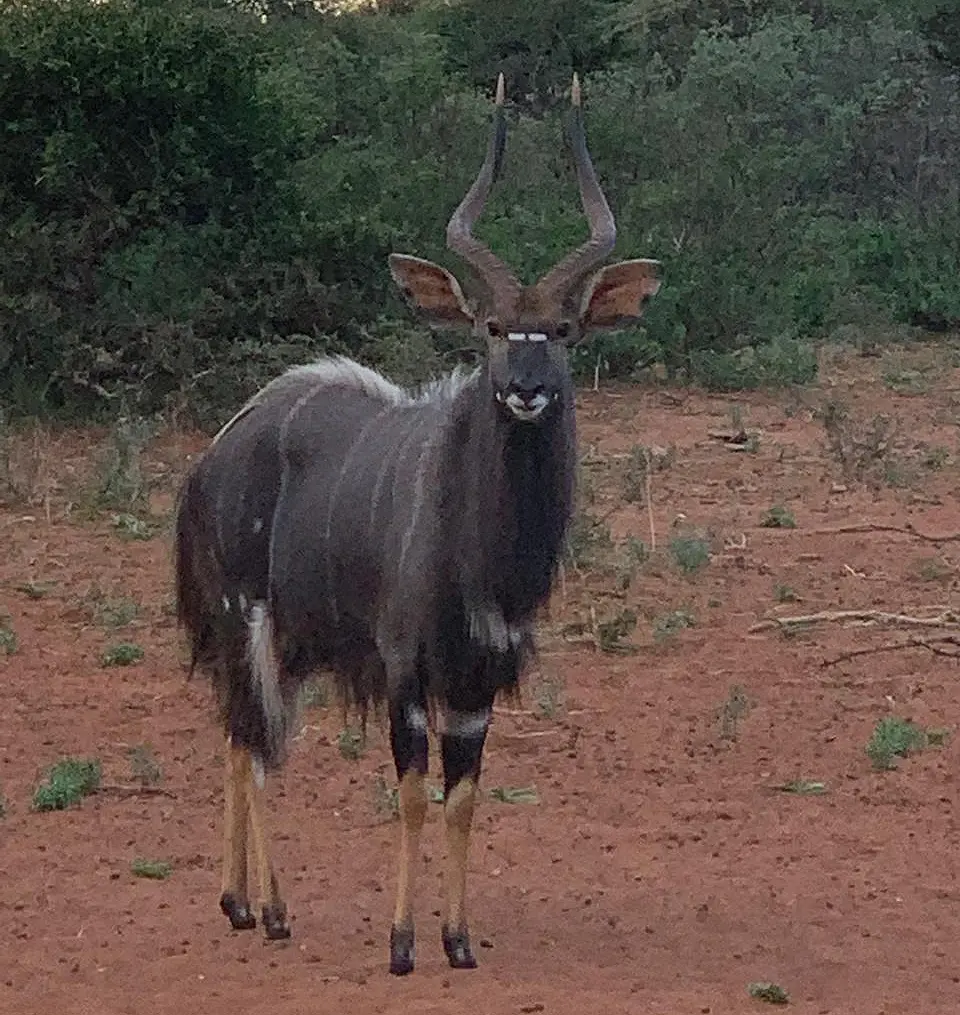
The nyala (Tragelaphus angasii) is a medium-sized, sexually dimorphic spiral-horned antelope found in the dense woodlands and thickets of south-eastern Africa. The difference between the sexes is remarkable. Mature bulls stand approximately 110 cm at the shoulder and weigh 100 to 140 kg. They are dark brown to charcoal grey with a shaggy coat, long dorsal crest that extends from the head to the tail, a prominent white chevron between the eyes, 10 to 14 vertical white body stripes, and vivid orange-yellow lower legs. The overall impression is of an animal both elegant and powerful.
Ewes and young males are strikingly different — bright chestnut-orange with clearly defined white stripes, resembling a completely different species at first glance. Only bulls carry horns, which are lyre-shaped with a single spiral of one to one and a half turns, tipped with ivory-yellow points. A mature bull’s horns typically measure 24 to 28 inches, with exceptional specimens exceeding 30 inches.
Nyala are predominantly browsers, feeding on leaves, fruits, flowers, and fresh grass shoots. They are most active during the early morning and late afternoon, spending the heat of the day resting in dense cover. They are naturally shy and secretive, preferring thick bush and rarely venturing far into open areas. This preference for dense habitat is what makes them such a challenging and rewarding species to hunt. Bulls are often solitary or found in small bachelor groups, though they may be encountered near ewes during the breeding season. Their alarm call is a distinctive, sharp bark that carries well through the bush.
The nyala is classified in the tribe Tragelaphini alongside the kudu, eland, sitatunga, and bushbuck — a group defined by the characteristic white body stripes and spots of the female and the spiral-horned males. Within this group, the nyala occupies a distinct ecological niche: more water-dependent than the kudu, more terrestrial than the sitatunga, and distinctly more secretive than either. Their preference for dense, tangled riverine vegetation makes them among the most rewarding of South Africa’s spiral-horned antelopes to pursue.
Sexual dimorphism in the nyala is among the most extreme in the antelope family. Adult females (ewes) are a striking chestnut-orange with white spots and vertical body stripes — a pattern shared with the bushbuck, reflecting their shared ancestry. Young males are similarly coloured to the females until they begin their transition at around 14 months of age. This transition from chestnut juvenile to fully dark adult takes approximately three to four years. A bull that still shows residual chestnut colouring on the flanks or neck is not a mature trophy animal, regardless of horn length — coat colour is the primary field indicator of age.
Adult bulls weigh 100 to 140 kg and stand 110 to 120 cm at the shoulder. Horns grow in an open lyre-shaped spiral with a typical length of 24 to 30 inches on a mature South African bull. Trophy evaluation focuses on horn length measured along the outer curve, the number of spiral turns, and the ivory colouring of the horn tips — a reliable indicator of genuine age rather than simply length.
Nyala occupy a restricted range in southern Africa, centred on the Zululand lowveld of KwaZulu-Natal and the Limpopo Province lowveld. This range overlaps almost exactly with the greatest concentration of safari hunting operations in South Africa, making nyala a natural combination target on any multi-species Limpopo safari. The species is strictly water-dependent and is rarely found more than two to three kilometres from a permanent water source — a dependence that shapes daily movement patterns and informs the most effective hunting strategies.
Nyala bulls are crepuscular by nature, with peak activity concentrated in the hour before sunrise and the first two hours after dawn, then again from around 4:00 p.m. until after dark. During the heat of the Limpopo day they retreat into dense thickets and mopane scrub, where their dark coats and the dappled light provide effective camouflage. Hunters who understand this rhythm — positioning at waterholes or riparian feeding edges during the crepuscular window — will consistently encounter more animals than those who walk through the bush at midday.
Older dominant bulls are frequently found alone or in the company of one or two younger males. These solitary animals are less vigilant than herd animals and offer the most favourable approach conditions. A bull accompanied by ewes and subadults is considerably harder to approach undetected, as the alert females provide an effective early warning system that the bull alone would not. On Gaspare Spanio Safaris’ Limpopo concessions, mature bulls are pre-scouted by the professional hunter before the hunt, and where possible a specific animal is identified and patterned before the client’s arrival.
How to Hunt Nyala in South Africa
Rifle Hunting
Rifle hunting is the most common method for nyala, and the typical approach reflects the animal’s preference for thick cover. The hunt often begins by slowly driving or walking the edges of dense thickets, riverine bush, and wooded drainage lines where nyala feed and shelter. When a bull is spotted — often just a glimpse of dark hide or orange legs through the vegetation — the stalk begins. Shots in nyala country are frequently taken at close range, sometimes inside 80 metres, through gaps in the bush. A low-powered variable scope (1-6x or 2-7x) is ideal for the fast target acquisition often required.
Caliber selection for nyala should balance adequate stopping power with the need for quick, accurate shooting in tight spaces. The .270 Winchester and .308 Winchester are ideal choices — both offer flat trajectory, manageable recoil, and sufficient energy for clean kills on an animal of this size. The .30-06 is equally suitable. Heavy magnum calibers are unnecessary and may actually be counterproductive due to excessive recoil when a fast, precise shot through a narrow gap is required. Use premium controlled-expansion bullets in the 150- to 165-grain range.
Bow Hunting
Bow hunting nyala is challenging but achievable, particularly from a blind set near a water source or along a known travel route between feeding and bedding areas. Nyala are cautious at water and may take considerable time to approach, requiring extended periods of absolute stillness from the bow hunter. A minimum draw weight of 60 pounds is recommended, with fixed-blade broadheads and heavy arrows for reliable penetration. Shot opportunities from blinds typically present at 15 to 25 metres. The thick bush environment means that blood trailing can be difficult, so shot placement must be precise to ensure a short recovery distance.
Walk and Stalk
Walk-and-stalk nyala hunting is the most immersive and rewarding method, offering a true bushveld experience. Your professional hunter will lead you slowly and quietly through the dense thickets that nyala call home, using tracks, droppings, and feeding signs to locate animals. The pace is slow and deliberate — nyala hunting is about stealth, not covering distance. The challenge is closing the distance in thick vegetation without being detected by the nyala’s excellent hearing and sense of smell. When a bull is located, you may have only a few seconds to identify the animal, confirm it is a mature trophy, find a clear shooting lane, and take the shot. This demands a high degree of readiness and composure. Walk-and-stalk nyala hunting is not for the impatient, but for those who enjoy the craft of hunting, there is no finer pursuit in the bushveld.
Where to Hunt
Nyala are native to the coastal lowveld of KwaZulu-Natal and Mozambique, but established, free-ranging populations now exist throughout Limpopo Province, where the dense bushveld thickets provide suitable habitat. Gaspare Spanio Safaris’ private concession includes extensive areas of riverine bush, dense Acacia thicket, and mixed woodland that are home to a healthy nyala population. The advantage of hunting nyala in Limpopo is the ability to combine this species with the full range of bushveld plains game — kudu, impala, warthog, zebra, and more — without travelling between properties. Nyala hunting South Africa in Limpopo has grown steadily in popularity as hunters recognise the quality of trophies available and the convenience of a multi-species bushveld safari.
Best Time to Hunt
Nyala can be hunted year-round, though each season offers different advantages. The dry winter months from May to September are generally preferred because the reduced leaf cover makes it easier to spot nyala in the otherwise impenetrable thickets. Animals are also more concentrated around permanent water sources during this period. However, nyala are browsers rather than grazers, so they are less affected by the seasonal drying of grasslands than species like zebra or wildebeest.
The rutting period, which peaks during autumn and early winter (March to June), can produce excellent hunting opportunities as bulls become more active and less cautious in their pursuit of receptive ewes. During the rut, bulls may be encountered in more open areas than usual, and they respond to the presence of other bulls with displays and posturing that can slow their escape when disturbed. The summer months bring lush vegetation that makes spotting difficult, but the experienced hunter who enjoys a close-quarters, sensory-rich hunt will find summer nyala hunting deeply satisfying.
What Is a Trophy Nyala? — Rowland Ward & SCI Standards
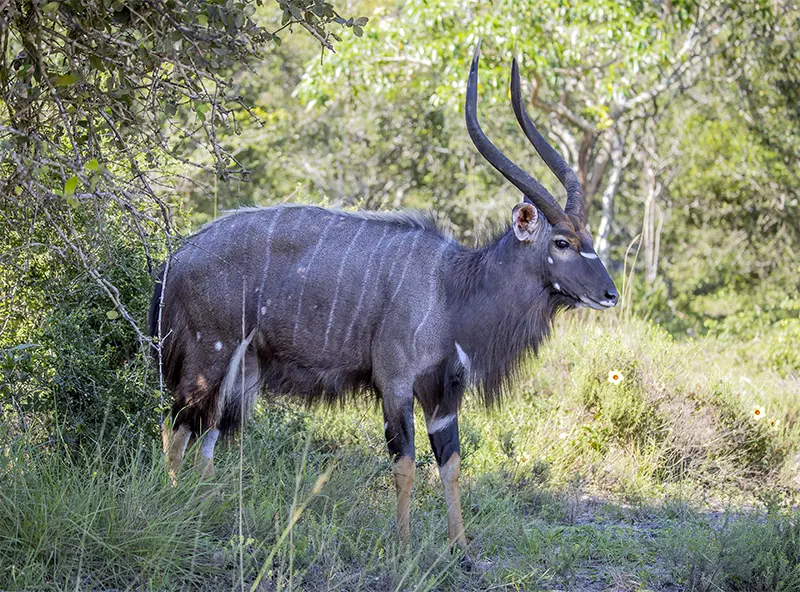
Nyala trophies are assessed on horn length, tip-to-tip spread, base circumference, and the number of spiral turns. A mature bull will display one to one and a half turns of spiral, with deep, prominent ridges along the lower half of the horns and smooth, ivory-coloured tips. The horns should sweep outward and then inward in an elegant lyre shape.
- SCI minimum entry score: 63 inches (combined measurements of horn lengths and circumferences)
- Rowland Ward minimum entry: 27 inches (single longest horn, measured along the spiral)
- Rowland Ward world record: 33⅛ inches — taken in South Africa
- SCI world record: 118⅜ points
A representative nyala bull will carry horns of 25 to 27 inches. Bulls exceeding 28 inches are very good trophies, and anything over 30 inches is exceptional. In the field, horn length can be estimated by comparing the horn tips to the ear tips — a nyala’s ears are approximately 7 to 8 inches long, and a bull whose horn tips extend well beyond the ear tips is likely carrying a trophy of 26 inches or more. The depth of the spiral ridges and the overall symmetry of the horns are also important quality indicators. Your professional hunter will assess these factors carefully before recommending the shot.
Current nyala trophy fees are listed on our South Africa Trophy Price List. Nyala rank among the higher-value plains game trophies due to their beauty and desirability.
Nyala Shot Placement — Vital Zones in Thick Bush
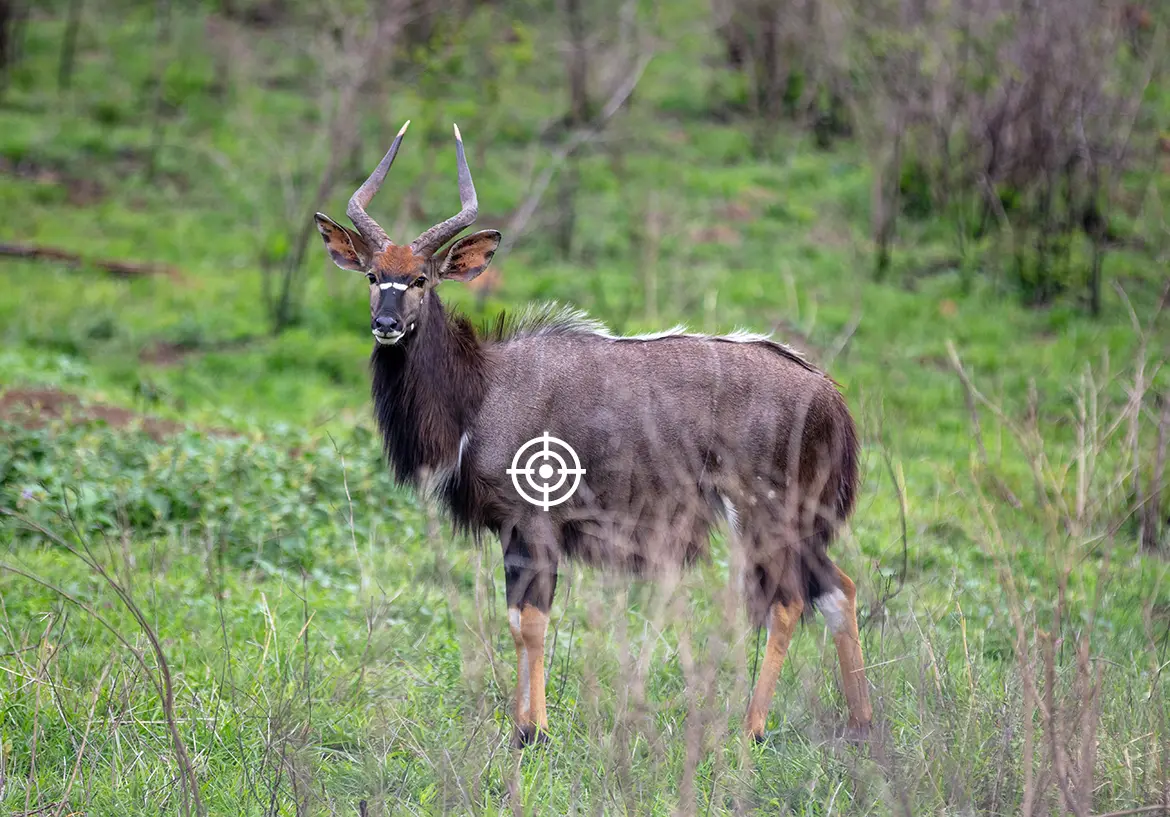
Shot placement on nyala follows the standard principles for medium-sized antelope, but the thick-bush environment in which they are hunted adds an additional layer of difficulty. For a full visual breakdown across all species, see our South Africa Shot Placement Guide. For a broadside shot, place the crosshairs directly behind the front shoulder crease, one-third of the way up from the bottom of the chest. This targets the heart and lungs for a clean, quick kill. The high shoulder shot — placed at the top of the shoulder blade — can anchor a nyala instantly but requires precise accuracy and is risky if shooting through gaps in the vegetation.
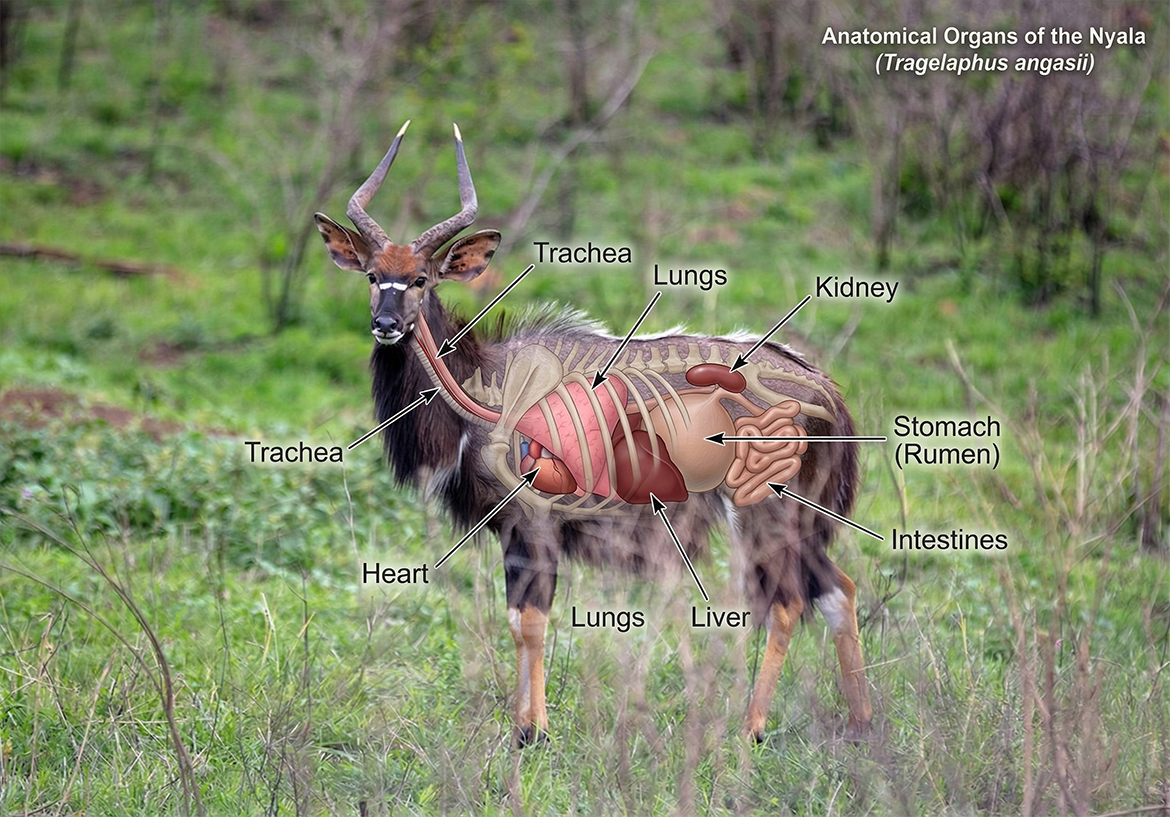
On a quartering-away shot, aim for the opposite front shoulder, placing the bullet through the ribs and diagonally into the vitals. This is often the most common angle presented in thick bush, as the bull is frequently moving away when you first acquire it in your scope. Avoid quartering-towards and frontal shots, particularly in thick bush where bullet deflection from intervening branches is a real concern. If you cannot see the full shoulder area clearly, do not shoot — nyala will often pause briefly before disappearing into cover, giving you a few seconds to find a clear lane. Your professional hunter will stop the animal with a whistle or sharp sound if possible, but you must be ready to shoot the instant a clear opportunity presents itself.
Recommended Calibers for Nyala Hunting
Nyala bulls weigh 100–140 kg and respond well to accurate shot placement with standard bonded bullets. They are not exceptionally tough animals, but the dense bush environment in which they are typically hunted demands sufficient penetration for quartering and angled shots through shoulder cover.
- .270 Winchester: An excellent all-round choice for nyala. A 150-grain bonded bullet delivers reliable performance on broadside and slightly quartering shots at the ranges typical of Limpopo bush hunting (40–120 metres).
- .308 Winchester / 7.62×51mm: One of the most widely used calibers in South Africa. Reliable, locally available, and highly accurate. A 165-grain bonded projectile is the standard selection for nyala-weight antelope.
- .30-06 Springfield: The classic African plains game cartridge. Handles all nyala shot scenarios with ease and provides a wide range of bullet weight options. A 180-grain bonded load is preferred for maximum penetration on quartering animals.
- 7mm Remington Magnum: Popular for its flat trajectory and retained energy at longer ranges. Useful when nyala are encountered in more open mixed bushveld rather than typical dense riverine cover, and a capable choice for hunters doubling up on kudu or gemsbok on the same safari.
Avoid light varmint calibers (.223 Rem, .243 Win under 90 grains) on nyala. The thick-bush hunting environment frequently demands shots at odd angles, where bullet integrity matters more than raw velocity. Premium bonded bullets — Federal Trophy Bonded, Swift A-Frame, Barnes TSX, or Nosler Partition — are proven performers that deliver consistent expansion and penetration across all realistic nyala shot scenarios.
Frequently Asked Questions
Why is nyala considered such a prestigious trophy?
The nyala’s combination of striking beauty, shy temperament, and challenging habitat makes it one of the most prized plains game trophies in Africa. A mature bull in full winter coat, with its dark shaggy hair, vivid orange legs, and elegant spiral horns, is one of the most visually dramatic animals on the continent. Many experienced hunters rank the nyala among their favourite African species, and shoulder mounts of quality bulls are centrepieces in trophy rooms worldwide.
How physically demanding is a nyala hunt?
Nyala hunting involves walking through thick bush on uneven terrain, often for extended periods. The pace is slow and deliberate rather than strenuous — think of it as a careful stalk rather than a hike. A moderate level of fitness is sufficient. The greater demand is mental: remaining alert, patient, and ready to shoot at a moment’s notice during what can be hours of slow, quiet walking through dense vegetation.
What is the difference between a nyala and a bushbuck?
While both are spiral-horned antelope found in thick bush, the nyala is significantly larger than the bushbuck (100-140 kg versus 30-80 kg). The mature nyala bull’s dark, shaggy coat and long dorsal mane are unmistakable, as are its orange legs. The bushbuck is more compact, with shorter, straighter horns and a less dramatic colour difference between the sexes. Both species may inhabit the same thickets, and your professional hunter will ensure correct identification before any shot is taken.
Can I combine a nyala hunt with other species?
Nyala hunting South Africa is frequently combined with other bushveld species. In fact, because nyala hunting involves slow, careful movement through thick bush, you will inevitably encounter other species during the stalk — bushbuck, impala, warthog, and kudu are all commonly seen in nyala habitat. A five- to seven-day safari allows ample time to pursue nyala alongside several additional species for a diverse and memorable hunting experience. Browse our hunting packages for pre-built plains game combinations.
What scope magnification do you recommend for nyala hunting?
Given the close-range, thick-bush nature of most nyala encounters, a low-powered variable scope is ideal. A 1-6x, 1.5-6x, or 2-7x provides the wide field of view and fast target acquisition needed for snap shots through narrow gaps in the vegetation, while still offering enough magnification for the occasional longer shot across a clearing. Keep the scope on its lowest setting while walking and only increase magnification if you have time before the shot. Avoid high-magnification scopes with narrow fields of view — in nyala country, speed matters more than precision at distance.
The nyala is one of Africa’s true trophies — an animal of breathtaking beauty that tests every aspect of your hunting ability. Pursuing a mature bull through the thick Limpopo bush is an experience that stays with you long after the safari ends. Contact Gaspare Spanio Safaris to book your nyala hunting South Africa adventure and add one of the continent’s most magnificent antelopes to your trophy room.
What is the effective hunting range for nyala?
The hunting environment dictates shot distance far more than the species itself. In typical nyala habitat — dense riverine thickets, mopane scrub, and tamboti bush — the great majority of shots are taken at 40 to 100 metres. Shots beyond 150 metres are uncommon and rarely necessary, as the professional hunter will almost always work to close the distance before presenting the shot opportunity. This close-range reality means bullet integrity on quartering and angled presentations is more critical than flat trajectory or long-range ballistics. A scope of 3–9× or 2–10× mounted on a solid hunting rifle is entirely adequate; the ability to dial down to 2–3× for close-range snap shots through vegetation is a practical advantage worth having.

