


About the Animal
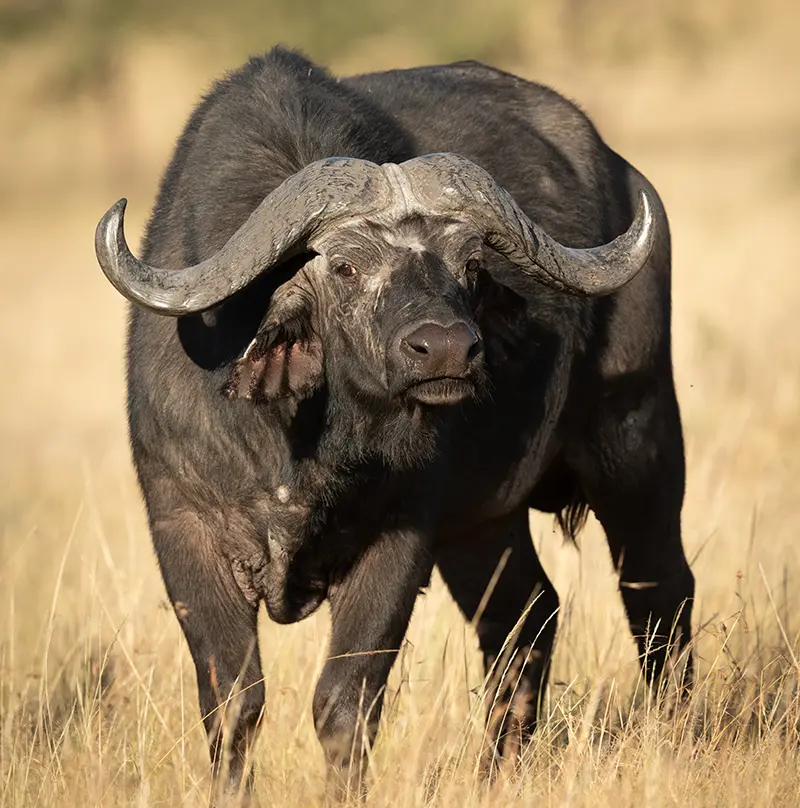
The Cape buffalo (Syncerus caffer) is a massive, powerfully built bovid that stands approximately 1.5-1.7 metres at the shoulder and weighs between 700 and 900 kg, with exceptional bulls exceeding 1,000 kg. The body is barrel-shaped and covered in sparse, dark brown to black hair that thins with age, revealing dark grey skin beneath. The buffalo’s most distinctive feature is its horns: in mature bulls, the horn bases fuse across the top of the skull to form a continuous, hardened shield known as the boss, from which the horns sweep downward and outward before curving upward at the tips. Boss development is the primary criterion for evaluating trophy quality and is directly correlated with age and dominance.
Cape buffalo are gregarious animals that form herds ranging from small groups of a dozen to massive aggregations of several hundred. Within these herds, a complex social hierarchy exists, with dominant bulls, breeding cows, and bachelor groups each occupying distinct roles. Old bulls that have been pushed out of the breeding herds by younger rivals — known as dagga boys, from the Zulu word for mud, after their habit of wallowing — form small bachelor groups or become solitary. These retired warriors are the primary targets of trophy buffalo hunts, as they are fully mature, carry the heaviest boss development, and are past their breeding prime.
The Cape buffalo’s reputation for danger is thoroughly deserved. Buffalo have excellent memory and will ambush hunters who wound them and attempt follow-up in thick bush. They are known to circle back on their own tracks and attack from behind — a tactic that has killed numerous hunters and professional guides throughout Africa’s hunting history. Their combination of size, speed, aggression, and intelligence when wounded makes the Cape buffalo the most dangerous of Africa’s Big Five to hunt on the ground at close quarters.
Hunting Methods
Rifle Hunting
Rifle hunting for Cape buffalo is governed by strict legal requirements. South African law mandates a minimum caliber of .375 H&H Magnum (or equivalent) for dangerous game, and this is a regulation that exists for excellent reason. The .375 H&H loaded with premium 300-grain bonded or solid bullets is the classic buffalo caliber and remains the most popular choice among professional hunters worldwide. For hunters who want additional insurance, the .416 Rigby, .416 Remington Magnum, and .458 Winchester Magnum are all excellent options that deliver greater energy and penetration. Whatever caliber you choose, use only premium, controlled-expansion bullets for the first shot (Swift A-Frame, Barnes TSX, Nosler Partition) and carry solids for follow-up shots. Your rifle must be utterly reliable — a jam or malfunction during a buffalo charge is a potentially fatal event.
The typical buffalo hunt involves locating fresh tracks early in the morning — often in the soft sand of a dry riverbed or around a waterhole — and then following the spoor on foot into increasingly thick bush. The tracking phase can last hours, covering several kilometres through dense vegetation with visibility sometimes measured in metres rather than tens of metres. When the buffalo are finally located, the professional hunter will assess the herd or bachelor group from whatever distance the bush allows, identify a suitable trophy bull, and position you for a shot. Distances are typically close — 40 to 80 metres — and the shot must be taken quickly and accurately before the animals detect you and flee or, worse, charge.
⚖️ South Africa Legal Requirements — Dangerous Game
- Minimum caliber: .375 H&H Magnum or equivalent — legally mandated by the South African Hunting and Reserves Act for Cape buffalo, lion, leopard, elephant, and hippo.
- PHASA accreditation: Your professional hunter must be a registered member of the Professional Hunters’ Association of South Africa (PHASA) and hold a valid dangerous game PH licence issued by the provincial authority.
- TOPS permit: Cape buffalo is listed under TOPS (Threatened or Protected Species) regulations — a TOPS hunting permit must be obtained from LEDET (Limpopo) before the hunt. Your outfitter handles all permit applications.
- Minimum hunting days: Provincial regulations in Limpopo require a minimum of 7 hunting days for dangerous game species.
Bow Hunting
Bow hunting Cape buffalo is legal in South Africa and represents the ultimate challenge for the serious archer. A compound bow with a draw weight of 80 pounds or more is recommended, paired with the heaviest arrow setup possible and fixed-blade broadheads designed for maximum penetration. Some bow hunters use single-bevel broadheads specifically designed for dangerous game. Shot placement must be absolutely precise — the buff’s thick hide, heavy ribs, and dense muscle require an arrow that can penetrate 15-20 inches to reach the vitals. Waterhole blinds at distances of 15-25 metres are the standard method. A professional hunter armed with a heavy-caliber rifle must be present as backup at all times. Bow hunting buffalo is not for the inexperienced — this is a pursuit that demands years of preparation and unwavering composure under extreme pressure.
Spot and Stalk
Tracking and stalking is the definitive method for hunting Cape buffalo, and virtually all buffalo hunts are conducted in this manner. The process begins at first light, when fresh tracks are identified and the pursuit commences on foot. An experienced tracker reads the spoor — foot size, depth, direction, freshness — to determine the age, sex, and number of animals, and to estimate how far ahead they are. As the tracking team closes the distance, the pace slows, voices drop to whispers, and every sense is heightened. The bush thickens. Visibility closes in. The first sign of the herd may be the sound of rumbling stomachs, the crack of breaking branches, or the sharp, musky smell that buffalo carry. This is the moment that defines dangerous game hunting — the point where the hunter must move forward into thick cover, knowing that a massive, aggressive animal with lethal horns is somewhere in the wall of green ahead. It is an experience of almost unbearable intensity, and it is what draws hunters back to Africa year after year.
Where to Hunt
Cape buffalo are found across sub-Saharan Africa wherever suitable habitat and protection exist. South Africa offers some of the finest buffalo hunting on the continent, with Limpopo Province being a premier destination. The thick bushveld, seasonal rivers, and abundant browse of Limpopo create ideal buffalo habitat, and carefully managed private properties produce trophy bulls with exceptional boss development. Gaspare Spanio Safaris operates buffalo hunts on their 3,000-hectare private game farm in Limpopo, where a healthy buffalo population is managed for trophy quality and sustainable utilisation. The property’s dense riverine bush and mixed woodland provide the classic thick-cover environment that makes buffalo hunting such an intense and immersive experience.
Hunting buffalo on a private property under the guidance of an experienced professional hunter ensures both safety and trophy quality. The PH team at Gaspare Spanio Safaris has extensive experience with dangerous game and manages every aspect of the hunt to the highest standards of safety and ethics.
Best Time to Hunt
Buffalo hunting South Africa is available year-round, but the optimal period is the dry winter months from May through October. During this time, water sources become concentrated, drawing buffalo to predictable areas and making them easier to locate. The reduced vegetation — particularly in the thick bush that buffalo prefer — improves visibility and makes tracking safer, as the hunter is less likely to walk into a buffalo at dangerously close range without warning. June through September is the prime window, offering cool mornings for comfortable tracking, dry conditions for reading spoor, and reliable animal movements around permanent water.
The early rains of October and November can also produce good hunting, as bulls are actively seeking out herds and may be encountered in more open areas. However, the increasing vegetation density during this period reduces visibility and increases the inherent danger of close-range encounters in thick bush. For the visiting hunter’s first buffalo, the dry season is strongly recommended.
What Makes a Trophy Buffalo? — Rowland Ward & SCI Standards
Cape buffalo trophies are evaluated primarily on boss development and horn spread. The minimum entry scores for the major record books are:
- SCI (Safari Club International) minimum: 101 inches (combined score including boss, horn length, and spread)
- Rowland Ward minimum: 42 inches (outside spread)
- Rowland Ward world record: 64⅜ inches (outside spread) — taken in Zimbabwe
- SCI world record: 131⅜ points
A truly exceptional buffalo will carry a spread of 44 inches or more, with a hard, fully fused boss that shows no gap between the horn bases. When evaluating a buffalo bull in the field, look first at the boss — in a mature bull, the boss should be solid, heavily ridged, and completely fused across the skull with no visible gap or soft centre. The horn tips should curl upward and ideally show some wear from age and fighting. Boss width, depth, and hardness are more important than horn tip length in determining trophy quality. Your professional hunter will evaluate multiple bulls before recommending a shot, and patience during the selection process is essential. A hard-bossed dagga boy with deep curls is worth far more as a trophy than a younger, wider bull with a soft boss.
Current buffalo trophy fees are listed on our South Africa Trophy Price List. Buffalo is priced on request due to the limited availability of mature trophy bulls — contact us for current pricing and availability.
Shot Placement For a Buffalo Hunt in South Africa
Shot placement on Cape buffalo is the single most critical factor in ensuring a safe and successful hunt. For a visual overview across all species, see our South Africa Shot Placement Guide. The margin for error is essentially zero — a poorly placed first shot on a buffalo can turn a controlled hunting situation into a life-threatening emergency. On a broadside presentation, the ideal shot is placed on the shoulder, approximately one-third of the way up from the bottom of the chest, directly in line with the front leg. This targets the heart and lower lungs and, with a .375 H&H or larger caliber, will typically break the shoulder on the near side and penetrate into or through the vitals.
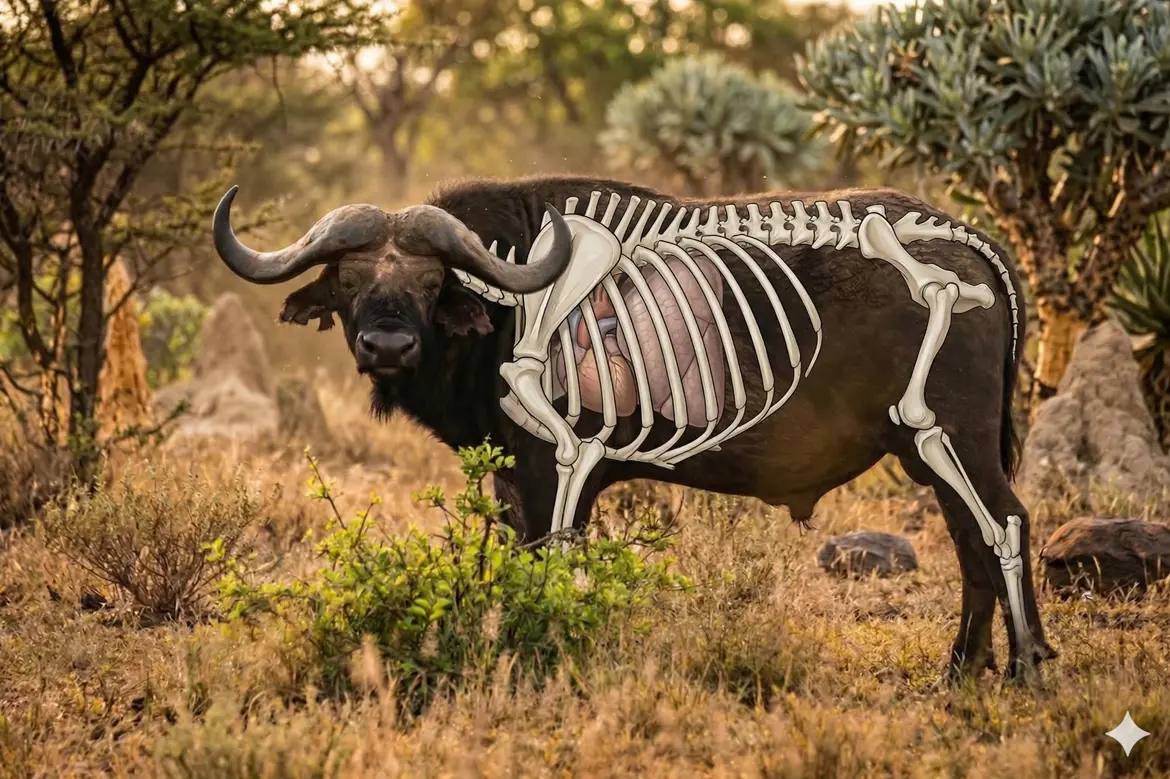
The so-called “buffalo triangle” is formed by a point on the centre of the shoulder, a point at the base of the neck, and a point at the bottom of the chest — any shot placed within this triangle will hit vital organs. Aim for the centre of this triangle. On a frontal presentation, aim for the centre of the chest where the neck meets the body — this is a smaller target but can be devastating with a heavy caliber. Avoid neck and head shots entirely unless you are making a finishing shot on a downed animal at point-blank range.

After the first shot, be prepared to shoot again immediately. The standard procedure is to reload and keep the rifle aimed at the buffalo, firing additional shots into the shoulder area until the animal goes down and stays down. Your professional hunter will also be shooting if necessary. Never approach a downed buffalo from behind, and always deliver an insurance shot to the base of the skull or neck before approaching closely. Your PH will direct every phase of the follow-up — listen to their instructions without hesitation.
What’s Included
A Cape buffalo hunting package with Gaspare Spanio Safaris typically includes:
- Experienced professional hunter specialising in dangerous game, with a full team of armed trackers and backup
- Premium lodge accommodation with full board — all meals, refreshments, and beverages
- 4×4 hunting vehicles, fuel, and all in-field transportation
- All necessary dangerous game hunting permits and provincial documentation
- Field preparation of your trophy — caping, skinning, and salting to taxidermy-ready standard
- Cold storage and coordination with your chosen taxidermist
- Rifle permit assistance and temporary firearm import documentation
- Airport transfers from Polokwane or Johannesburg
- Laundry service, daily housekeeping, and lodge amenities
The buffalo trophy fee is among the highest in African hunting, reflecting the animal’s status as one of the continent’s most prestigious and dangerous trophies. Taxidermy, dipping and packing, international shipping, and gratuities are additional. A full cost breakdown will be provided before booking, and your outfitter will help you understand every component of the investment.
Frequently Asked Questions
What is the minimum legal caliber for buffalo in South Africa?
South African law requires a minimum caliber of .375 H&H Magnum (or equivalent energy) for hunting Cape buffalo and other dangerous game. This is a strict legal requirement, not a suggestion. Most professional hunters recommend the .375 H&H as the standard buffalo caliber, with the .416 Rigby, .416 Remington Magnum, and .458 Winchester Magnum being popular alternatives for hunters who prefer additional stopping power. Whichever caliber you choose, practise extensively before your hunt — you must be able to place your first shot accurately under pressure, as there may not be time for a careful second shot if the buffalo charges.
How dangerous is buffalo hunting really?
Cape buffalo have killed more hunters in Africa than any other member of the Big Five. Their intelligence, aggression, and tendency to ambush when wounded make them genuinely life-threatening quarry. However, when hunted under the guidance of an experienced professional hunter with proper equipment and preparation, the risks are managed to an acceptable level. The keys to safety are: using adequate caliber, placing the first shot correctly, maintaining composure under pressure, and following your PH’s instructions at all times. Accidents happen when hunters take marginal shots, use inadequate calibers, or fail to listen to their guide.
How long does a typical buffalo hunt take?
Most buffalo hunts are booked for 7-10 days, though a bull can sometimes be taken within the first two or three days. The tracking and selection process is inherently unpredictable — some days you may track for hours without locating the herd, while on other days you may encounter buffalo within the first hour. The selection process also requires patience, as the PH must evaluate multiple bulls before identifying a mature, trophy-quality animal worth harvesting. Allow enough time in your schedule for the hunt to unfold naturally.
What permits do I need for buffalo hunting South Africa?
Buffalo hunting in South Africa requires a valid hunting permit issued by the relevant provincial authority (in Limpopo, this is LEDET — the Limpopo Department of Economic Development, Environment and Tourism). Your outfitter will arrange all necessary permits, TOPS (Threatened or Protected Species) documentation, and provincial authorisations on your behalf. You will also need a temporary firearm import permit, which allows you to bring your rifle into South Africa for the duration of your hunt. Allow at least 6-8 weeks before your departure for permit processing. Gaspare Spanio Safaris handles all documentation as part of the booking process.
Can I combine buffalo with plains game on the same safari?
Absolutely, and most hunters do. A common approach is to book a 10-14 day safari that combines buffalo with several plains game species such as kudu, impala, warthog, and blue wildebeest. See our hunting packages for pre-built combination safaris. The buffalo is typically the primary focus, with plains game hunted on days between tracking sessions or after the buffalo has been taken. This approach maximises the value of your time in Africa and allows you to experience the full spectrum of South African hunting — from the adrenaline of dangerous game to the relaxed enjoyment of pursuing plains game across the bushveld.
The Cape buffalo stands alone as Africa’s ultimate hunting challenge — a trophy that represents the pinnacle of the sport and an experience that will define your career as a hunter. Contact Gaspare Spanio Safaris to begin planning your buffalo hunting South Africa expedition. Our team of experienced dangerous game professionals will guide you through every step, from booking and permits to the final handshake over your fallen bull. Contact us today to secure your place on one of Africa’s most unforgettable hunts.
Related Hunts
Hunters who pursue Cape Buffalo also enjoy these species:
- Crocodile Hunting South Africa
- Hippopotamus Hunting South Africa
- Eland Hunting South Africa
- Kudu Hunting South Africa
View all huntable species at Gaspare Spanio Safaris.

