


About the South African Giraffe
The South African giraffe (Giraffa camelopardalis giraffa) is the largest of the recognised giraffe subspecies. Mature bulls stand up to 5.5 metres in height and weigh between 1,000 and 1,400 kilograms — a size that defies comprehension until you are standing beside one in the bush. Cows are smaller, typically reaching 4.5 metres and weighing 700 to 950 kilograms.
The giraffe’s distinctive patchwork coat — irregular dark brown to chestnut patches separated by lighter cream-coloured lines — is unique to each individual, functioning as a form of fingerprint. In South Africa, the patches tend to be large and deeply coloured, with well-defined borders that become darker and more saturated as the bull ages. An old bull in full dark colouration is among the most visually striking animals in Africa.
Giraffes are exclusive browsers, feeding primarily on the leaves, shoots, and seed pods of acacia, combretum, and other trees. Their extraordinary neck length allows access to foliage unavailable to any other browsing species, and their prehensile tongues — measuring up to 45 centimetres — are perfectly adapted for stripping leaves from between thorns without injury. In the Limpopo bushveld, giraffes are most commonly seen feeding on tall acacia and mopane trees.
Despite their graceful, slow-motion appearance, giraffes are formidable animals. Mature bulls establish dominance through “necking” contests — swinging their long necks and landing blows with their ossicones (horn-like protrusions on the skull) that can be heard from a considerable distance. Their legs are powerful weapons: a giraffe kick has sufficient force to kill a lion. They possess excellent eyesight, scanning the landscape from their extraordinary vantage point, and can detect movement at great distances — a trait that makes foot stalks genuinely challenging despite the animal’s size.
Giraffe Hunting Methods
Spot and Stalk
Spot-and-stalk is the standard method for giraffe hunting and the most authentic way to pursue this species. The hunt begins with locating a suitable bull — either from a vehicle while driving the property or on foot through open woodland. Giraffe can be seen from remarkable distances due to their height, but the challenge lies in closing within ethical shooting range (typically 80 to 150 metres) without being detected.
The stalk itself is an unusual experience. Giraffes inhabit relatively open terrain and their height means they can see over most available cover. A successful approach requires patience, careful wind management, and the ability to use every available fold in the ground and tree line for concealment. Moving slowly and deliberately — stopping whenever the giraffe raises its head — is the key. The approach can take two to four hours. When you finally arrive within range of a five-metre-tall animal at close quarters, the effect is profound.
Trophy Assessment
Selecting the right bull is the most critical element of a giraffe hunt. Your professional hunter will spend time observing potential animals before any stalk is committed to. Key indicators of a mature, post-breeding bull:
- Coat colour: Mature bulls develop increasingly dark, saturated patches. An old bull will be very dark — almost black — compared to the lighter brown of younger animals and cows.
- Ossicones: In mature bulls, the ossicones (the two main “horns” plus the central bump on the forehead) become smooth and heavily calcified with age, often developing additional calcium deposits across the top of the skull. Young bulls and cows have hair-covered ossicone tips.
- Body condition: Old post-breeding bulls may show signs of age — a leaner body, a more pronounced dewlap, and overall muscle loss compared to prime bulls.
- Neck: Mature bulls have noticeably heavier, more muscular necks than cows or young males.
Only clearly mature, post-breeding bulls past their reproductive prime are cleared for harvest at Gaspare Spanio Safaris. Your professional hunter makes the final call — never rush this assessment on a premium species.
Where to Hunt Giraffe in South Africa
Giraffe are found across South Africa’s bushveld regions, with the strongest populations on private game reserves in Limpopo, North West, and parts of the Northern Cape. Limpopo Province is particularly well suited to giraffe hunting — the open mixed bushveld, tall acacia stands, and mopane woodland provide ideal habitat, and private reserves in the region have built significant populations over the past three decades.
Gaspare Spanio Safaris operates on a 3,000-hectare private game farm in the Limpopo bushveld where giraffe are resident year-round. The property’s combination of open grassland, acacia woodland, and riverine thicket provides authentic habitat and allows for genuine spot-and-stalk hunting in a fair-chase environment.
Best Time to Hunt Giraffe
Giraffe can be hunted year-round in Limpopo, but the dry winter months from May through September offer the most favourable conditions. The reduction in foliage during winter significantly improves visibility and makes spotting and approaching bulls easier. Cooler temperatures make for more comfortable hunting days, particularly important when covering ground on foot during a stalk. The dry season also concentrates animals around permanent water sources, providing additional hunting opportunities.
What Is a Trophy Giraffe? — Scoring & Mount Options
Giraffe trophies are not scored by the major record books in the traditional sense — there are no Rowland Ward or SCI horn measurements for giraffe, as the ossicones are not considered “horns” under record-book definitions. Trophy quality is instead assessed subjectively by coat colour, ossicone development, and overall body size — all of which correlate directly with age.
The truly exceptional aspect of a giraffe trophy is its scale and visual impact. Mount options include:
- Full shoulder mount: The most dramatic option — a full giraffe shoulder mount requires ceiling heights of at least 4.5 metres but creates an unparalleled centrepiece. Few trophies in the hunting world make a statement comparable to a full giraffe shoulder in a large space.
- Pedestal mount (head and neck): The most popular practical option. A giraffe head-and-neck pedestal requires less display space than a full shoulder and is still an extraordinary trophy piece.
- European skull mount: Shows the ossicones and skull structure — a clean, modern option for hunters who prefer minimalist presentation.
- Skin: Giraffe hide is exceptionally thick and beautifully patterned, making outstanding material for furniture, ottomans, floor mats, and decorative pieces. Many hunters tan the skin in addition to a head mount.
Current giraffe trophy fees are listed on our South Africa Trophy Price List. Giraffe is priced as a premium species — contact us for current availability and full cost breakdown.
Giraffe Shot Placement — High Heart, Heavy Caliber
Shot placement on a giraffe is unlike any other species and must be understood clearly before the hunt. For a visual overview of shot placement across species, see our South Africa Shot Placement Guide.
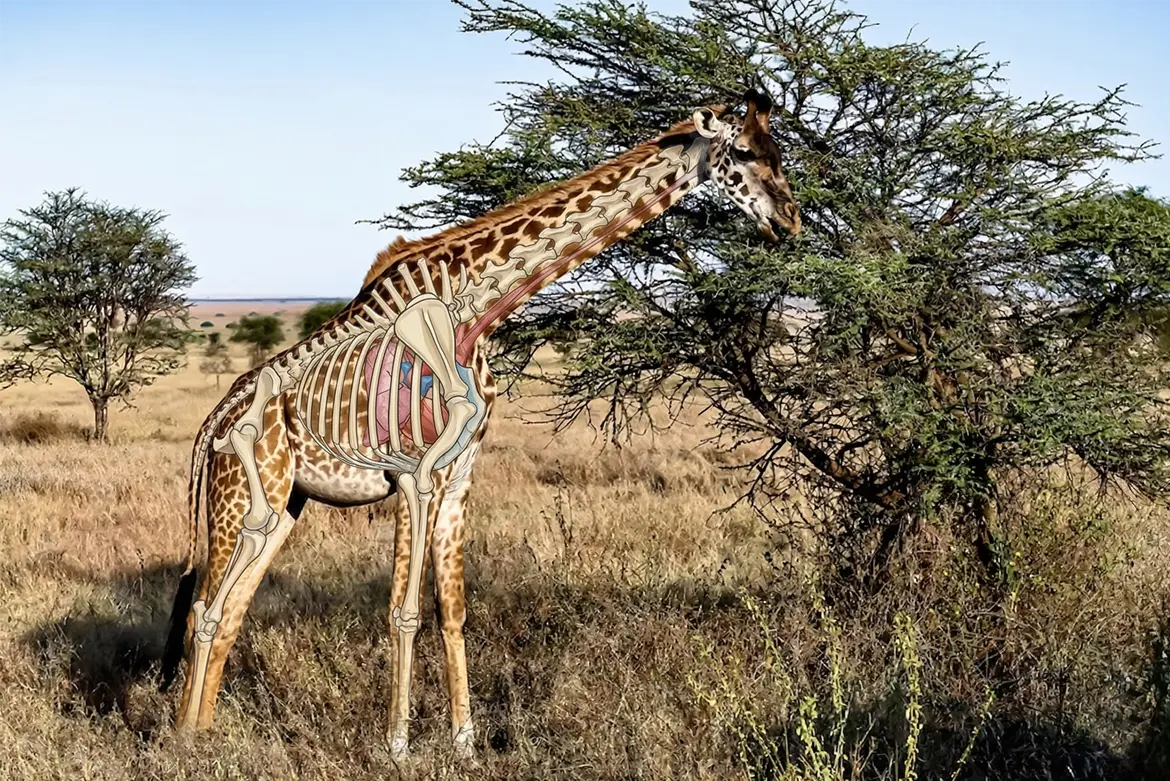
The giraffe’s heart is located significantly higher in the chest cavity than most hunters expect — roughly in the centre of the body when viewed from the side, not near the bottom of the chest as on antelope. On a broadside giraffe, the correct aiming point is at the centre of the shoulder, approximately one-third of the way up the body from the bottom of the chest. This targets the heart and lower lungs and is the most reliable killing shot. Many hunters, accustomed to aiming lower on other species, shoot too low on giraffe — a mistake that results in a leg or brisket hit with serious consequences.
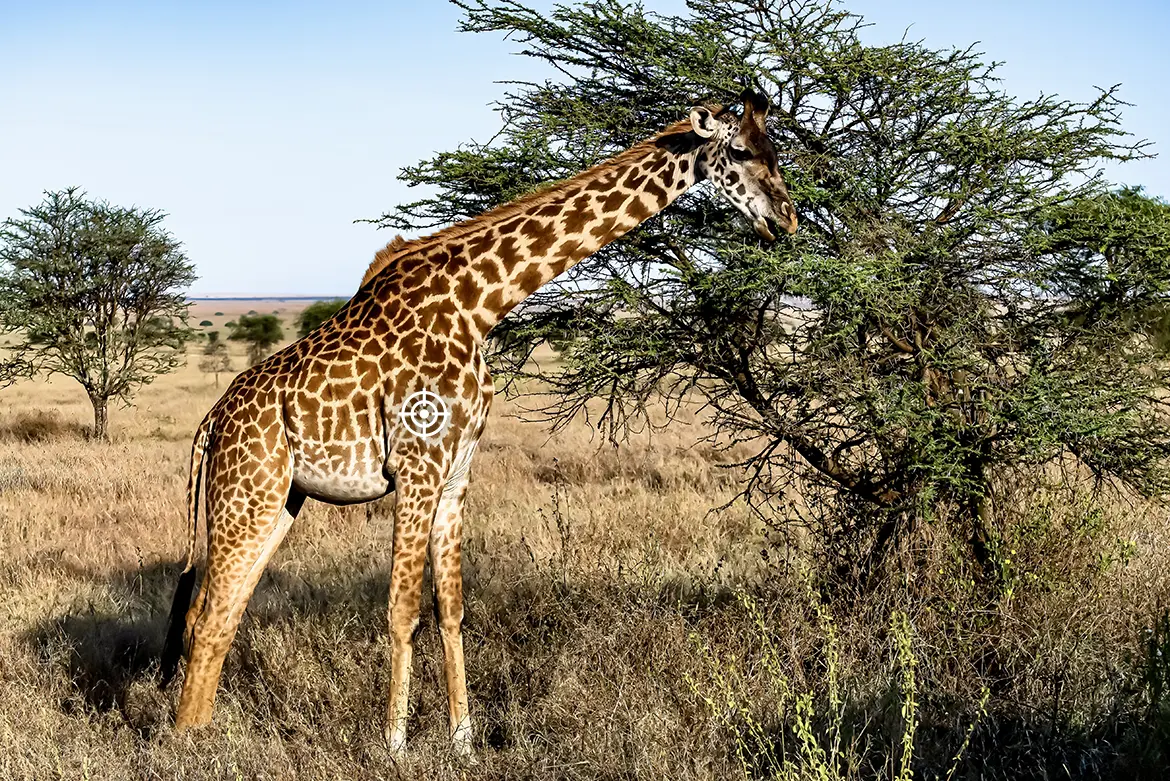
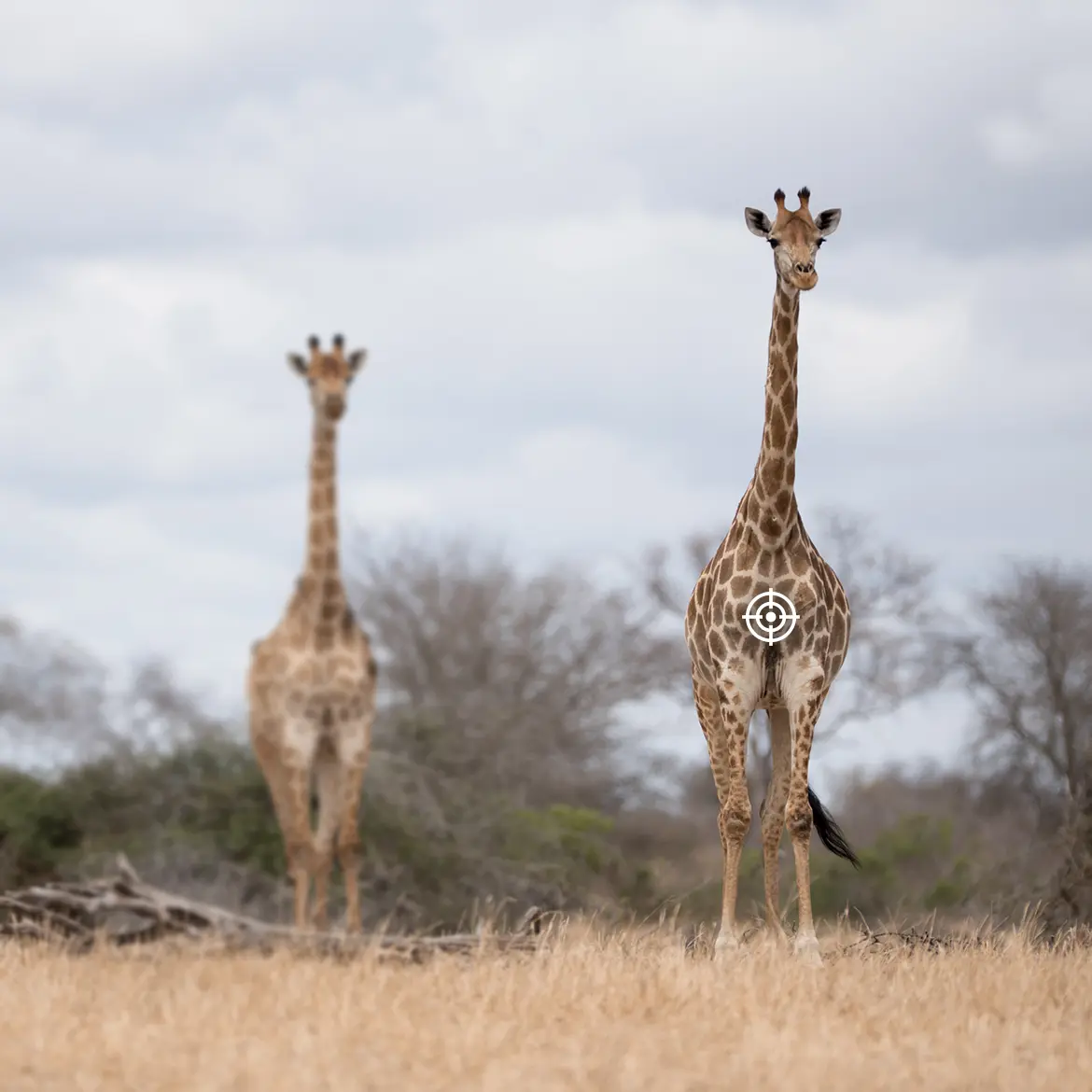
Your professional hunter will mark the correct aiming point before the shot and will not allow a shot until the angle and distance are ideal. On a quartering-away giraffe, aim for the off-side shoulder, placing the bullet through the chest cavity. Avoid frontal shots and steep quartering-toward angles.
Required Calibers
A minimum caliber of .375 H&H Magnum is legally required for giraffe and other dangerous-sized game in South Africa. The giraffe’s enormous body mass, thick hide, and heavy bones demand deep-penetrating, heavy bullets. Recommended choices:
- .375 H&H Magnum (300 gr solid or bonded): The legal minimum and a reliable choice with quality ammunition.
- .416 Rigby / .416 Remington Magnum: Preferred by many professional hunters for the additional energy and penetration margin.
- .458 Winchester Magnum: Excellent stopping power for follow-up shots if required.
Use only premium, controlled-expansion or solid bullets — Swift A-Frame, Barnes TSX, Woodleigh, or Hornady DGX. Rapid-expansion hunting bullets are not appropriate for an animal of this size and density.
What’s Included in Your Giraffe Hunt
- Experienced professional hunter with giraffe hunting expertise
- Full-board lodge accommodation with all meals and beverages
- 4×4 hunting vehicle and all in-field equipment
- Tracker and field staff
- Field preparation of your trophy — skin, skull, and ossicone preparation
- Coordination with taxidermist and shipping agent
- Airport transfers from Polokwane or Johannesburg
Giraffe hunting is most commonly combined with a broader plains game safari. Popular pairings include kudu, impala, warthog, and blue wildebeest. Browse our hunting packages or contact us to build a custom multi-species safari.
Frequently Asked Questions
Is it ethical to hunt giraffe?
Yes. Giraffe hunting on private game reserves in South Africa is part of a scientifically managed conservation model. Revenue from hunting funds habitat conservation, anti-poaching operations, and wildlife management infrastructure. The selective removal of old, post-breeding bulls maintains herd health and opens resources for younger breeding animals. South African private reserves now hold the largest and fastest-growing giraffe populations on the continent — a direct result of the economic incentive provided by hunting and ecotourism revenue.
What is the conservation status of giraffe in South Africa?
The South African giraffe subspecies (Giraffa camelopardalis giraffa) is classified as Least Concern by the IUCN, with populations stable to increasing, particularly on private land. South Africa’s private reserve model has been one of the most successful wildlife conservation stories in Africa — giraffe populations on fenced private properties have grown significantly since the 1990s, driven largely by the financial returns from ethical hunting and wildlife management.
How many days should I allow for a giraffe hunt?
A dedicated giraffe hunt typically requires two to three hunting days — one for locating and assessing potential trophy bulls, and one to two for the stalk and shot. We strongly recommend combining your giraffe hunt with a broader plains game safari of seven to ten days to make the most of your time in Limpopo and ensure you are not under pressure to take the first bull encountered.
Can I bring the skin home?
Yes. Giraffe skin can be exported from South Africa under CITES Appendix II regulations with the appropriate export permits, which your outfitter will arrange. The skin is prepared by dipping and packing at a registered South African facility before export. Processing and shipping typically takes four to six months. Check import regulations for your home country — the USA, EU, and most other markets permit giraffe skin imports under CITES documentation.
Contact Gaspare Spanio Safaris to discuss a giraffe hunt in Limpopo. Availability is limited — reach out early to secure your preferred dates and begin planning one of Africa’s most unforgettable hunting experiences.

