


About the Kudu
The kudu belongs to the tragelaphine family of spiral-horned antelopes, and two distinct species are recognised across Africa. The Greater Kudu (Tragelaphus strepsiceros) is the species found throughout South Africa’s bushveld regions and is the primary target for hunting safaris. Standing up to 1.5 metres at the shoulder and weighing between 190 and 270 kg, a mature bull is an imposing animal. The Lesser Kudu (Tragelaphus imberbis) is a smaller, more elusive species found only in East Africa — primarily Kenya, Tanzania, and Ethiopia — and is not present in South Africa.
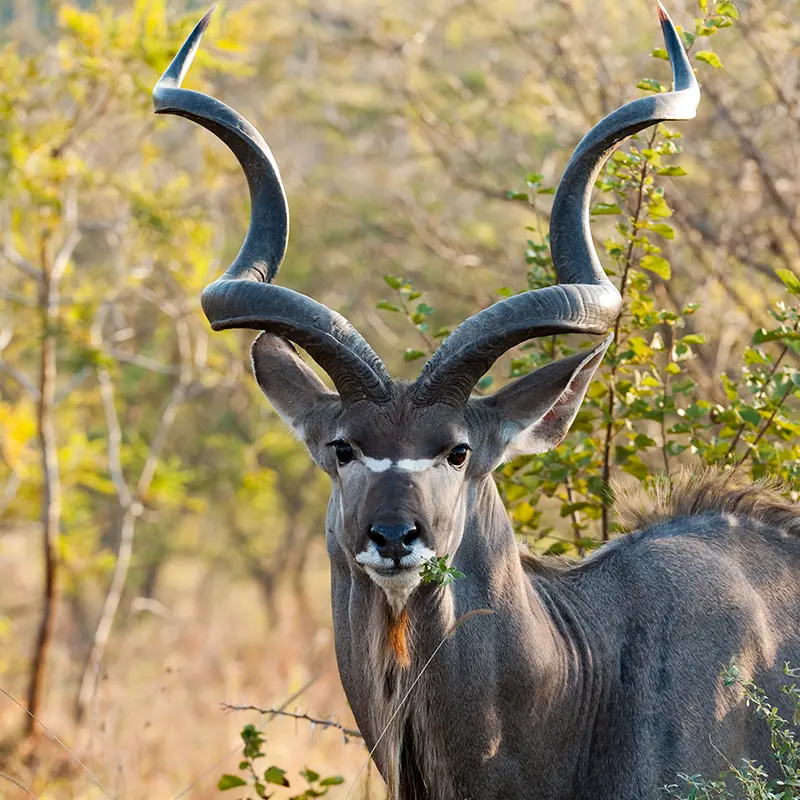
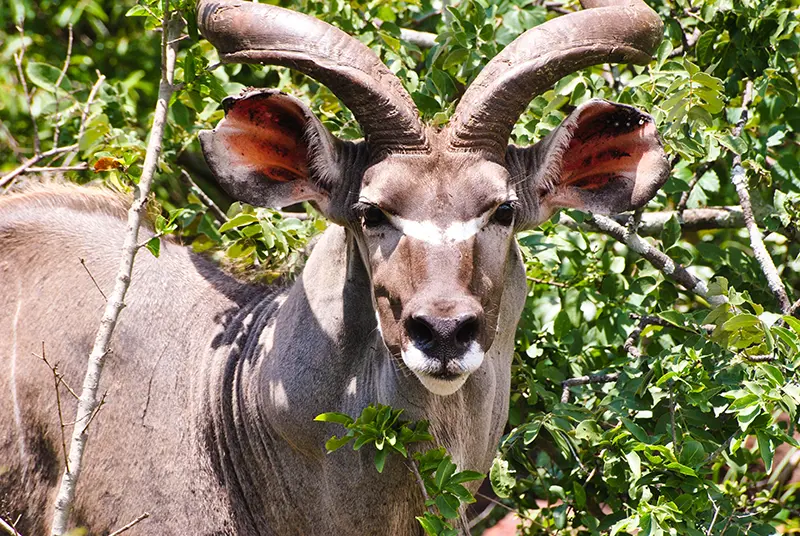
Greater Kudu bulls carry magnificent corkscrew horns that can reach lengths exceeding 60 inches along the curve. Their coats are a blue-grey to brown-grey with six to ten distinctive white vertical body stripes, providing remarkably effective camouflage in dense bush. A prominent dorsal crest runs along the spine, and mature bulls display a thick beard of hair along the throat and dewlap.
Kudu are predominantly browsers, feeding on leaves, shoots, seed pods, and fresh growth from over 100 different plant species. They favour dense woodland, riverine thickets, and hillside bush where cover is plentiful. Their home ranges are relatively small — typically 3 to 10 square kilometres — but they move within those ranges with an uncanny ability to detect danger. Their oversized, radar-like ears pick up the faintest sounds, and they rely heavily on a combination of hearing and scent. Kudu are most active during early morning and late afternoon, spending the midday hours resting in dense cover.
What makes the kudu so prized among hunters is the sheer difficulty of the pursuit. Despite their size, kudu bulls can vanish into surprisingly thin bush. They have a habit of freezing motionless when they detect potential danger, making them nearly invisible against the grey and brown tones of the African bush. When they decide to flee, they do so with explosive speed, clearing two-metre fences with ease. This combination of wariness, camouflage, and terrain makes kudu hunting in South Africa a genuine test of hunting skill.
Hunting Methods
Rifle Hunting
Rifle hunting is the most common and practical method for taking kudu in South Africa. A mature bull is a large, tough animal with a deep chest cavity, so adequate caliber selection is essential. The .30-06 Springfield loaded with a quality 180-grain bonded or controlled-expansion bullet is the minimum recommended caliber, and it remains a superb choice for kudu. The .308 Winchester with 165- or 180-grain premium bullets is equally effective at typical bushveld distances. For hunters who prefer a flatter trajectory and more energy at range, the 7mm Remington Magnum or .300 Winchester Magnum are excellent options, particularly where shots may stretch beyond 200 metres in more open terrain.
Most shots at kudu in thick Limpopo bushveld occur between 80 and 180 metres, though opportunities can present at closer or longer range depending on terrain. A rifle that shoots sub-MOA groups with the chosen hunting ammunition and a quality variable-power scope in the 3-12x or 4-16x range will serve you well. Shooting sticks are standard equipment — practice off sticks before your hunt, as few shots are taken from a bench rest in the African bush.
Bow Hunting
Bow hunting kudu is a deeply rewarding experience that demands even more patience and discipline than rifle hunting. A minimum draw weight of 70 lbs is recommended for kudu, paired with heavy, well-tuned arrows weighing at least 450 grains total. Fixed-blade broadheads are strongly preferred over mechanicals — a quality two- or three-blade cut-on-contact broadhead with a cutting diameter of at least 1⅛ inches provides reliable penetration through the kudu’s thick hide and heavy rib bones.
Effective bow range on kudu is typically 20 to 35 metres. Shots beyond 40 metres are inadvisable given the kudu’s lightning reflexes and ability to “jump the string.” Even at moderate distances, a kudu can drop and spin before the arrow arrives, so quiet equipment and careful shot selection are paramount.
Walk and Stalk
Walk and stalk is the classic method for kudu hunting and the approach most experienced hunters prefer. You and your professional hunter (PH) will move slowly through the bush at first light, glassing ahead and to the flanks, looking for the tell-tale signs of kudu — a flicker of an ear, horizontal body stripes through vertical tree trunks, or the curve of horn tips above a thorn bush. Fresh spoor and browse sign are used to determine the general area bulls are feeding, and the stalk begins from there. Wind management is critical, as kudu will scent a hunter at considerable distances. Expect to cover 8 to 15 kilometres per day when hunting on foot.
Blind Hunting
Hunting from a ground blind positioned near water, mineral licks, or established feeding routes is the primary method for bow hunters and an effective option during the dry winter months when water sources concentrate game. Blinds are set up well in advance to allow animals to become accustomed to the structure. Hunters enter the blind before dawn and may sit for several hours. This method demands patience and stillness but offers close-range opportunities that are difficult to engineer on foot. Blind hunting is particularly effective during the kudu rut when bulls move more freely during daylight hours.
Where to Hunt Kudu in South Africa
Greater Kudu are found across most of South Africa’s bushveld regions, but certain provinces consistently produce the best trophies. Limpopo Province is widely considered the premier kudu hunting destination in the country, thanks to its vast tracts of mixed bushveld, abundant browse species, and well-managed private concessions that allow bulls to reach full maturity. The terrain here — a mix of acacia-dominated valleys, rocky koppies, mopane woodland, and riverine bush — is ideal kudu habitat.
The Eastern Cape produces excellent kudu in its thick valley bushveld, and the North West and KwaZulu-Natal provinces also hold huntable populations. However, for consistent trophy quality and a genuine wilderness hunting experience, Limpopo remains the top choice for serious kudu hunters.
Gaspare Spanio Safaris operates on a 3,000-hectare private game farm in the heart of Limpopo’s bushveld. The property encompasses varied terrain — from dense riverine thickets to open savanna and rocky hillsides — providing ideal habitat for a strong population of mature kudu bulls. The farm is managed with strict selective harvesting to ensure trophy quality is maintained year after year. Hunting on a private concession of this size means no interference from neighbouring operations and full control over the hunting experience.
Best Time to Hunt Kudu
Kudu can be hunted year-round in South Africa under the appropriate permits, but the optimal window is from May through September — the dry winter months. During this period, deciduous vegetation drops its leaves, improving visibility through the bush and making it significantly easier to spot and stalk kudu. Water sources dry up and concentrate game around the remaining pans and boreholes, further increasing encounter rates.
The kudu rut typically peaks from late May through July, and this is arguably the best time to hunt a trophy bull. During the rut, bulls become less cautious and more active during daylight hours as they seek out receptive cows. Mature bulls that are normally nocturnal or crepuscular may be encountered feeding or moving in open areas during mid-morning and early afternoon. They also spar with rival bulls, and the sound of clashing horns can occasionally be used to locate them.
Daytime temperatures in Limpopo during the winter hunting season range from 10°C to 25°C, with cold mornings and comfortable midday conditions. Rainfall is minimal, making for pleasant hunting days and accessible terrain. The combination of reduced vegetation, concentrated water, rutting behaviour, and mild weather makes the May to July period the prime time for kudu hunting in South Africa.
What Is a Trophy Kudu? — Rowland Ward & SCI Standards
A kudu bull is typically judged by the length of his horns measured along the outer spiral curve, the depth of the curls, the spread, and the number of completed spirals. A mature bull will have at least two and a half spirals, with truly exceptional animals showing close to three full turns.
- SCI Minimum Score: 121 inches (combined length of both horns)
- SCI World Record: 393⅞ points
- Rowland Ward Minimum: 53⅞ inches (longest single horn, measured along outer curve)
- Rowland Ward World Record: 73½ inches — taken in Zimbabwe
- Average Mature Trophy: 48 to 55 inches per horn
- Exceptional Trophy: 55 to 60+ inches per horn
When evaluating a bull in the field, your PH will assess the horn tips relative to the ears. If the tips extend clearly above the ear tips, the bull is likely in the 50-inch-plus class. If the third spiral is well developed and the tips point upward and outward, you are looking at a very good trophy. Ivory-tipped horns — where the last several inches are smooth and pale — indicate age and are a hallmark of a truly mature bull, typically eight years or older.
Horn mass, while not a primary measurement for the record books, adds significantly to the visual appeal of a trophy. A bull with thick, deeply ridged bases and heavy horns throughout will always look more impressive on the wall than a long but thin-horned animal.
Shot Placement For a Kudu Hunt in South Africa
Correct shot placement is the single most important factor in a clean, ethical harvest. The kudu’s deep chest and heavy shoulder structure require precise bullet or arrow placement to ensure a quick kill.
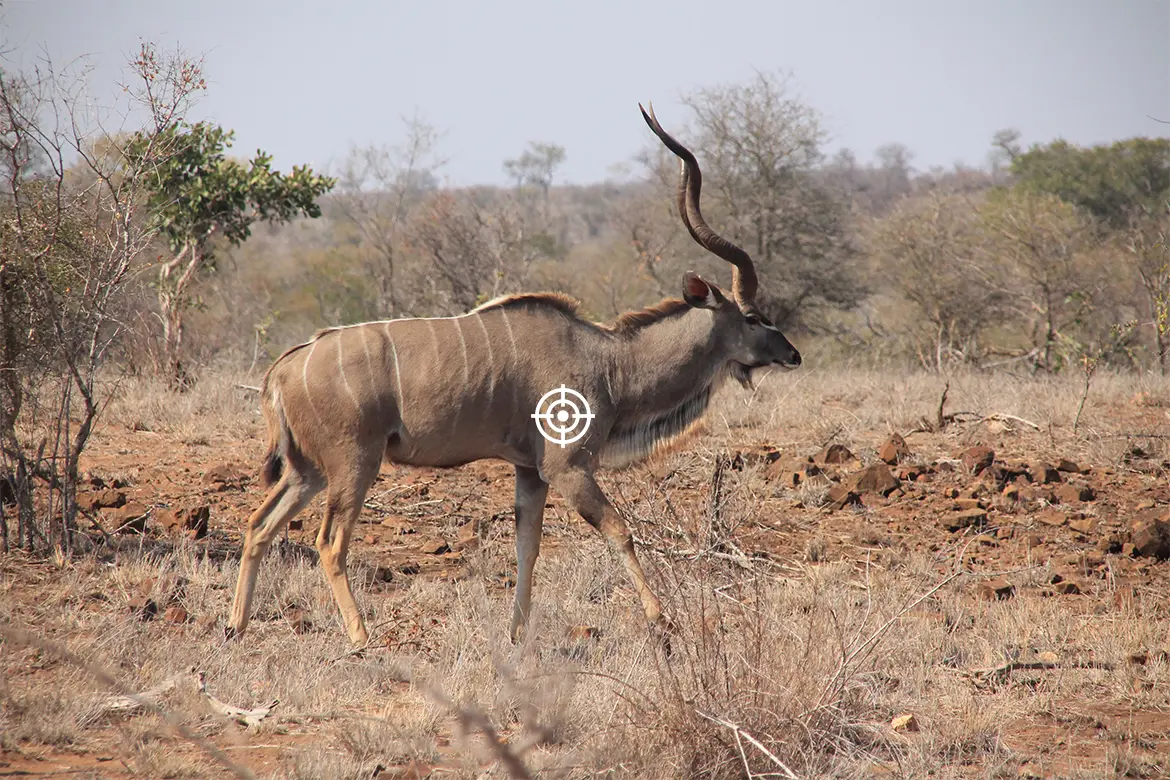
Broadside Shot (Recommended)
For a broadside rifle shot, place the crosshair directly on the line of the front leg, approximately one-third of the way up from the bottom of the chest. This puts the bullet squarely through the heart and lower lungs. Many hunters make the mistake of shooting too high on a kudu — the vital zone sits lower in the chest than most expect. Avoid shooting at the centre of the visible body mass, as this will result in a high lung or even a spine shot that may not be immediately fatal.
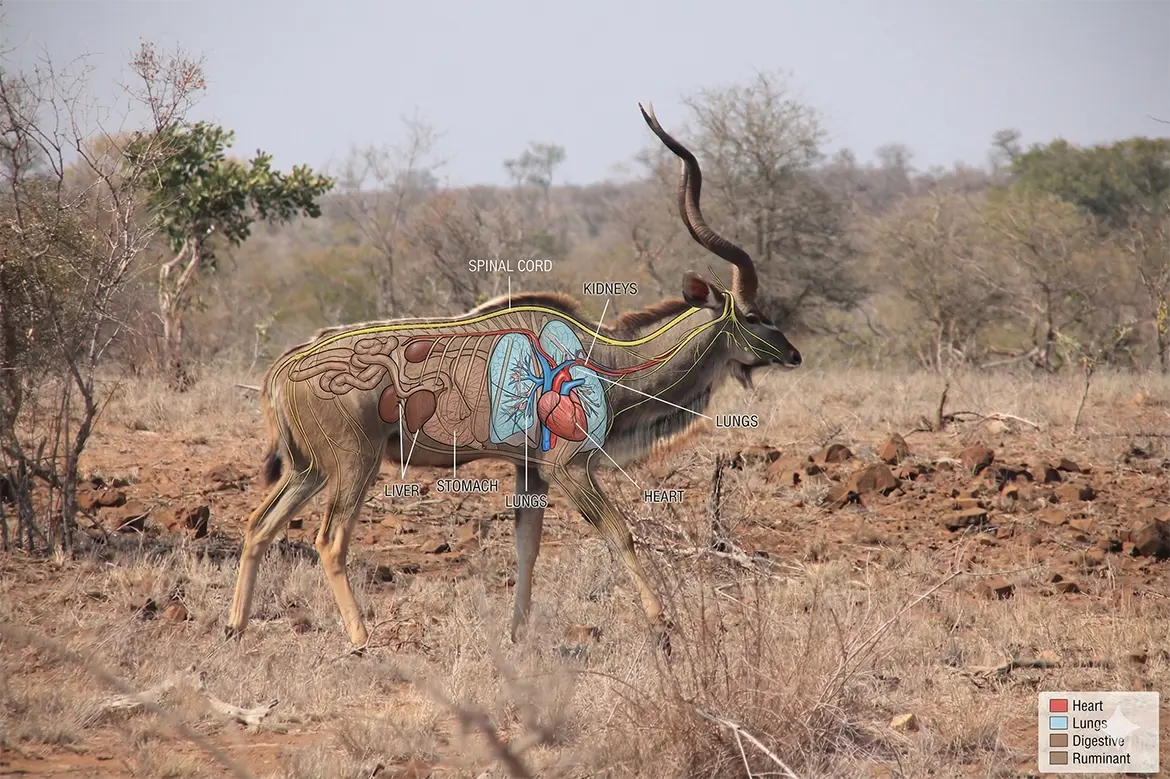
Quartering-Away Shot
On a quartering-away shot, aim for the off-side shoulder. Place the shot behind the last rib on the near side, angling forward so the bullet exits through or just behind the far shoulder. This path takes the bullet through the liver and both lungs, and is a highly effective killing angle. Do not attempt a quartering-toward shot on kudu unless you are using a large-caliber rifle with heavily constructed bullets, as shoulder bone deflection can cause poor penetration.
Frontal Shot (Avoid)
A frontal shot on kudu should be avoided in almost all circumstances. The neck and chest muscles, combined with the heavy shoulder bones, make reliable penetration to the vitals extremely difficult. The target zone — the base of the throat/top of the brisket — is small and requires precise aim under pressure. Even experienced hunters with large-caliber rifles pass on frontal shots unless circumstances make it unavoidable. For bow hunters, a frontal shot is never acceptable; the kudu’s heavy shoulder blade and thick hide will almost certainly result in insufficient penetration.
Bow Shot Placement
For bow hunters, shot placement is even more critical. The ideal shot is a broadside presentation with the near-side leg stepped forward, opening the chest cavity. Place your pin tight behind the front leg crease, one-third up from the brisket line. This targets the heart and lower lungs. A quartering-away angle is also acceptable, aiming to exit through the far-side shoulder. Never take a frontal or quartering-toward shot with a bow — the kudu’s heavy shoulder blade and thick hide will almost certainly result in insufficient penetration. Wait for the right angle, even if it means passing on the opportunity.
Regardless of weapon, give the animal adequate time after the shot before following up. For rifle shots, wait 10 to 15 minutes. For bow shots, a minimum of 30 to 45 minutes is advised, and longer if you suspect a liver hit. A well-placed shot will rarely require a long tracking job, but patience after the shot prevents pushing a wounded animal into thick cover.
Recommended Calibers for Kudu Hunting
A mature kudu bull is a large, heavily built animal — the caliber you choose must be capable of reliable penetration through heavy muscle, thick hide, and large bones to reach the vitals. Light-for-caliber or rapid-expansion varmint bullets are not appropriate.
- .30-06 Springfield (180 gr bonded): The benchmark choice — adequate energy, proven performance, widely available. An excellent all-round kudu and plains game rifle.
- .308 Winchester (165–180 gr premium): Equally effective at typical bushveld distances. Choose bonded or controlled-expansion projectiles.
- 7mm Remington Magnum: A flat-shooting option well-suited to more open terrain where longer shots are possible.
- .300 Winchester Magnum: Offers additional energy and range for hunters who also intend to pursue larger or dangerous game on the same safari.
Most shots at kudu in Limpopo bushveld occur between 80 and 180 metres. For a full caliber breakdown across all South African species, see our Best Rifle Caliber for South Africa Hunting guide.
What’s Included in Your Kudu Hunt
At Gaspare Spanio Safaris, kudu hunting packages are structured to give you a complete safari experience with no hidden costs. A typical kudu hunt is conducted over five to seven hunting days, which allows adequate time to be selective and pursue a mature trophy bull without rushing the experience.
Included in your hunt:
- Daily rates covering professional hunter (PH) services, one-on-one guiding
- Comfortable lodge accommodation on the private game farm
- All meals and refreshments during your stay
- Field preparation and skinning of trophies
- Transportation within the concession during hunting
- Tracker and skinning staff
Additional costs to budget for:
- Trophy fee for kudu (quoted separately and payable on harvest)
- Taxidermy and shipping of trophies to your home country
- Ammunition (bring your own — South African law permits import with correct permits)
- Flights to and from South Africa
- Gratuities for PH, trackers, and lodge staff
- Dip and pack services for export preparation
Combination hunts are highly popular and cost-effective. Many hunters pair kudu with other Limpopo plains game species such as impala, blue wildebeest, warthog, bushbuck, and nyala — another of Limpopo’s most sought-after spiral-horned trophies. Adding species to your safari maximises your time in the field and provides outstanding value. Browse our South Africa hunting packages for pre-built combinations, or contact us for a custom quote tailored to your wish list and budget.
Frequently Asked Questions
How physically demanding is a kudu hunt?
Kudu hunting on foot requires a moderate to good level of fitness. You should be comfortable walking 8 to 15 kilometres per day over uneven terrain in warm conditions. That said, the pace is slow and deliberate — this is not a mountain hunt. Hunters of all ages successfully pursue kudu provided they can walk steadily for several hours and handle the occasional quick stalk through thick bush. Blind hunting is an excellent low-impact alternative for those with mobility concerns.
What is the average shot distance for kudu?
In Limpopo bushveld, most rifle shots on kudu occur between 80 and 180 metres, with the average around 120 metres. Shots under 80 metres are common in thick riverine bush, and occasional opportunities may present at 200 metres or slightly beyond in more open areas. For bow hunters, the average shot from a blind is between 20 and 30 metres.
Can I hunt kudu with a bow?
Absolutely. South Africa is one of the world’s premier bow hunting destinations, and kudu is one of the most popular bow hunting targets. A minimum draw weight of 70 lbs is recommended, and hunting is typically conducted from a well-positioned ground blind near water or feeding routes. Walk-and-stalk bow hunting for kudu is possible but extremely challenging due to the animal’s acute senses. We recommend a minimum of seven hunting days for a bow hunt to allow for the additional time required.
What caliber rifle do you recommend for kudu?
The .30-06 Springfield with 180-grain premium bullets is the benchmark recommendation and an excellent all-round choice for kudu and other South African plains game. The .308 Winchester, 7mm Remington Magnum, and .300 Winchester Magnum are all equally effective. Use quality bonded or controlled-expansion ammunition from reputable manufacturers. Avoid light-for-caliber bullets and rapid-expansion varmint-type projectiles — kudu are tough animals that require deep-penetrating bullets to reach the vitals reliably.
How do I import my firearms into South Africa?
South Africa permits visiting hunters to import firearms under a temporary import permit (SAPS 520 form), which is processed on arrival at the airport by the South African Police Service. You may bring up to four firearms and 200 rounds of ammunition per firearm. Your outfitter will provide the necessary invitation letter and documentation well in advance of your trip. The process typically takes 30 to 60 minutes at the airport. We recommend arriving on a direct international flight to OR Tambo International Airport in Johannesburg.
What is the success rate on kudu?
On our Limpopo concession, the success rate for rifle hunters on a five-to-seven-day kudu hunt is consistently above 90 percent. We maintain a healthy population of mature bulls through careful management, and our experienced PHs know the property intimately. Bow hunting success rates are naturally lower — typically around 70 to 80 percent over a seven-day hunt — due to the closer range required and the limited shot opportunities. Patience and selectivity from the hunter are the primary factors that determine success.
Ready to pursue the Grey Ghost? Gaspare Spanio Safaris offers a personalised, professional kudu hunting experience on our private Limpopo concession. Whether you are a first-time safari hunter or a seasoned Africa hand looking for a truly mature trophy bull, we will craft a hunt tailored to your goals. Contact us today to discuss availability, pricing, and your ideal South African hunting safari.
Related Hunts
Hunters who pursue Kudu also enjoy these species:
- Nyala Hunting South Africa
- Eland Hunting South Africa
- Bushbuck Hunting South Africa
- Gemsbok Hunting South Africa
View all huntable species at Gaspare Spanio Safaris.

