


About the Ostrich
The common ostrich (Struthio camelus) is the largest living bird, with adult males standing up to 2.7 metres tall and weighing between 100 and 160 kilograms. Males are striking birds with bold black plumage contrasted by white wing and tail feathers, while females are a more subdued grey-brown. Their long, powerful legs are their primary defence — a single kick can kill a lion, and their running speed of up to 70 km/h makes them the fastest bird on land.
Ostriches are found across the grasslands, savannas, and semi-arid regions of South Africa. They are omnivorous, feeding on seeds, grasses, flowers, insects, and small reptiles. Their enormous eyes — the largest of any land vertebrate — give them exceptional eyesight, allowing them to detect predators and hunters from great distances.
Despite being flightless, ostriches are superbly adapted to their environment. Their ability to survive without drinking water for extended periods (obtaining moisture from food) and their remarkable speed and endurance make them highly successful in the harsh African landscape.
Ostrich Hunting Methods
Ostrich hunting requires patience and the ability to shoot accurately at moderate distances:
- Spot and stalk: Ostriches are located in open grassland and savanna, often from a vehicle, and then stalked on foot using available cover. Their exceptional eyesight makes approach challenging — any movement at long range will be detected. Low vegetation, termite mounds, and dry riverbeds can provide cover for the approach.
- Ambush at water: During dry periods, setting up near water sources can be effective as ostriches visit to drink and bathe. Patience is required, as they may approach cautiously and from unexpected directions.
- Early morning hunts: Ostriches are most active during cooler parts of the day. Early morning is often the best time, when they are feeding and less alert than during the heat of midday.
Shooting distances are typically 100 to 200 metres. Ostriches appear to be an easy target due to their size, but their speed and wariness make getting within range a real challenge.
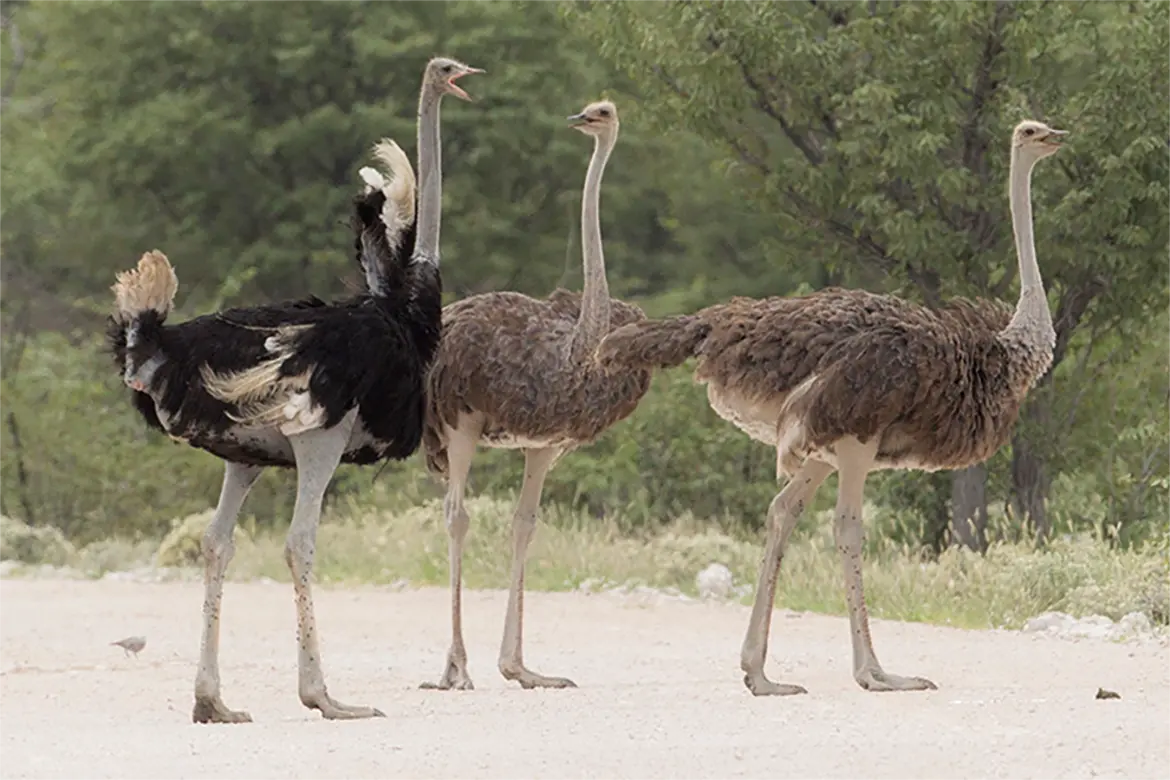
What Is a Trophy Ostrich? — Feathers, Leather & Mounts
The ostrich offers multiple trophy components. The primary feather plumes — particularly the white wing and tail feathers of the male — are highly prized and have been valued in fashion and decoration for centuries. Ostrich leather is one of the most expensive and sought-after exotic leathers in the world, used for boots, bags, belts, and wallets. The eggs (often found in nests) can be decoratively carved or painted.
Full-body mounts of an ostrich are spectacular but require substantial display space. Neck-and-head mounts are a more practical option. Many hunters also choose to have the skin professionally tanned for leather goods as a lasting memento of the hunt.
Ostrich are recorded by the SCI record book under their bird category. The SCI minimum for ostrich is based on skull measurement. Current trophy fees are listed on our South Africa Trophy Price List.
Ostrich Shot Placement — Body Vitals & Caliber
Shot placement on an ostrich differs from mammalian game. For a visual overview of shot placement across all species, see our South Africa Shot Placement Guide. The bird’s vital area — heart and lungs — is located in the upper body cavity, well forward and higher than most hunters expect. The recommended aiming point on a broadside ostrich is the centre of the body mass where the base of the neck meets the torso. This places the bullet through the heart and major blood vessels.
Avoid headshots — the small, moving head is an unreliable target, and a miss or graze will result in a wounded, fleeing bird that is extremely difficult to follow up. A body shot through the vitals is far more reliable and humane.
Recommended calibers are .243 Winchester through .270 Winchester. These calibers provide adequate energy and flat trajectory for medium-range shooting. The .243 is sufficient for a well-placed shot, while the .270 offers more margin for error on an animal that may be moving.
Best Time to Hunt Ostrich in South Africa
Ostrich can be hunted year-round in Limpopo, but the dry winter months from May through September are most productive:
- Visibility: Sparse dry-season vegetation in open grassland and savanna makes locating and approaching ostriches significantly easier.
- Behaviour: Ostriches are less water-stressed and more active during the cooler winter months, moving more freely across open terrain.
- Breeding season (July–September): Males are at their most visible during the breeding season, displaying striking black plumage and actively competing for females — ideal for trophy identification.
- Comfortable conditions: Cooler winter temperatures make long periods of glassing and stalking in open terrain much more pleasant.
Ostrich hunting pairs well with impala and warthog as part of a Limpopo plains game safari. Browse our hunting packages for multi-species combinations.
Frequently Asked Questions
Can you eat ostrich meat?
Yes, and it is excellent. Ostrich meat is a lean, red meat similar in taste and texture to beef fillet. It is low in fat and cholesterol and high in protein. At Gaspare Spanio Safaris, your ostrich will be prepared for a memorable safari dinner — grilled ostrich fillet over an open fire is a camp favourite.
Is the ostrich endangered?
No. The common ostrich is listed as Least Concern by the IUCN. South Africa has large wild populations as well as an extensive ostrich farming industry. Hunting wild ostriches is fully legal and sustainably managed within provincial regulations.
How fast can an ostrich really run?
An ostrich can sprint at up to 70 km/h and maintain speeds of 50 km/h for extended periods. This makes them faster than any predator over distance. A wounded ostrich can cover enormous ground very quickly, which is why precise shot placement is essential. Your professional hunter will ensure you are in position for a clean, ethical shot before firing.
Hunters who pursue Ostrich also enjoy these species:
- Springbok Hunting South Africa
- Zebra Hunting South Africa
- Giraffe Hunting South Africa
- Red Hartebeest Hunting South Africa
View all huntable species at Gaspare Spanio Safaris.
Hunt the world’s largest bird in the African bushveld. Contact Gaspare Spanio Safaris to add an ostrich to your South African hunting safari — a unique trophy and an unforgettable experience in Limpopo.

