


About the Hippopotamus
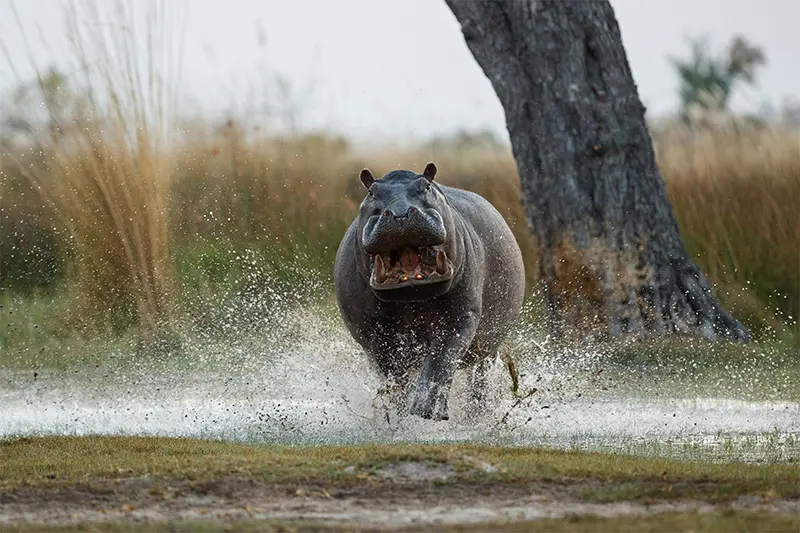
The common hippopotamus (Hippopotamus amphibius) is the third-largest land mammal after the elephant and white rhinoceros. Adult bulls weigh between 1,500 and 2,000 kilograms, with exceptional individuals exceeding 2,500 kilograms. Despite their rotund, seemingly docile appearance, hippos are incredibly aggressive and surprisingly fast — capable of reaching speeds of 30 kilometres per hour on land over short distances.
Hippos are semi-aquatic, spending most of the day submerged in rivers, dams, and lakes to keep their sensitive skin cool and protected from the sun. They emerge at dusk to feed, grazing on grass for 5 to 6 hours each night, consuming up to 40 kilograms of vegetation. Their territorial nature, unpredictable temperament, and powerful jaws — capable of biting a small boat in half — make them one of Africa’s most dangerous animals.
Bull hippos are fiercely territorial in water and will defend their stretch of river against all intruders, including other hippos, crocodiles, and humans. The massive canines and incisors can reach 50 centimetres in length and are used as weapons in dominance fights that are often fatal.
Hippo Hunting Methods — Water & Land
Hippo hunting is a specialised and deliberate pursuit conducted near water:
- Hunting from the bank: The most common method involves locating a pod of hippos in a river or dam, identifying a mature bull, and taking a carefully placed brain shot while the animal is in the water with its head exposed. This requires a solid rest and extreme precision.
- Ambush on land: During the night or early morning, hippos may be encountered on their grazing paths between water and feeding areas. Ambushing a hippo on land is dangerous but offers a broader target and more shot placement options.
- Trophy assessment: Identifying a mature bull in a pod requires experience. Your professional hunter will assess size, tusk wear, scar patterns, and behaviour to identify the dominant bull or an appropriate trophy animal.
The critical challenge in hippo hunting is the shot placement. When a hippo is in water, only the top of the head — eyes, ears, and nostrils — is typically visible. The brain is a small target at a specific angle, and the shot must be placed with absolute precision.
What Is a Trophy Hippo? — Rowland Ward & SCI Standards
A hippo trophy is measured by tusk length — the lower canines are the primary measurement, with the lower incisors as a secondary measurement. A good trophy bull will have lower canines of 30 centimetres or longer. The massive tusks, made of ivory-like dentine, are among the most impressive trophies in African hunting.
Full skull mounts showcasing the enormous jaws and tusks are the most popular display option. Full-body mounts are possible but require substantial space. Hippo teeth can be carved into decorative pieces, and the thick hide can be tanned for leather goods. A hippo skull mount is a dramatic and conversation-starting trophy.
Hippo trophies are assessed primarily on the length of the lower canine teeth. The Rowland Ward minimum is 25 cm (lower canine length); the world record stands at 64 cm — taken in Zambia. The SCI minimum combines lower canines and lower incisors; the SCI world record is 187⅛ points. A representative mature bull from a well-managed concession will carry lower canines of 30 to 40 cm.
Current hippo trophy fees are listed on our South Africa Trophy Price List. Hippo is priced as a dangerous game species — contact us for current availability and full cost breakdown.
Hippo Shot Placement — Brain Shot & Vital Zones
Shot placement on a hippo is the single most critical factor in the hunt. For a visual overview of shot placement across dangerous game species, see our South Africa Shot Placement Guide. A body shot on a hippo in water will result in a wounded animal that sinks and may never be recovered. The only effective shot on a hippo in water is a brain shot.
When the hippo is facing you in the water, aim between the eyes, slightly above the line connecting them. On a broadside animal in water, aim just behind the eye at the ear opening. On land, a broadside heart/lung shot is also effective — aim behind the shoulder at the midpoint of the body.
The minimum legal caliber is .375 H&H Magnum, and this is also the most commonly recommended caliber. Solid or premium bonded bullets are essential for penetrating the massive skull bone. Your professional hunter will provide detailed guidance and will not permit a shot until the angle and conditions are correct.
Best Time to Hunt Hippo in South Africa
Hippo hunting is possible year-round, but conditions vary significantly by season:
- Dry season (May–September): Lower water levels concentrate hippos in smaller areas and reduce the number of suitable pods, making identification and access more manageable. Clearer water also improves visibility of submerged animals.
- Winter months: Cooler temperatures reduce heat stress and make extended bankside vigils more comfortable. Hippos emerge from water to graze earlier in the evening during cooler weather.
- Year-round availability: Unlike many plains game species, hippo hunts are not strongly seasonal. The most important factor is water level — your professional hunter will advise on current conditions at the time of your safari.
Hippo hunting is most commonly combined with Cape buffalo or other Big Five species to create a comprehensive dangerous game safari. See our hunting packages for multi-species options.
Frequently Asked Questions
How dangerous is hippo hunting?
Hippo hunting is classified as dangerous game hunting for good reason. Wounded hippos in water are virtually impossible to follow up, and hippos on land can charge with devastating speed. However, with an experienced professional hunter managing the hunt — as is always the case at Gaspare Spanio Safaris — the risks are carefully controlled. Safety is always the first priority.
What happens after the shot?
If the brain shot is placed correctly, the hippo will be anchored immediately. A hippo shot in water will initially sink, then float to the surface within a few hours as gases build. Your professional hunter and team will manage the recovery process, which can be logistically challenging due to the animal’s enormous size and aquatic habitat.
How long does a hippo hunt take?
A dedicated hippo hunt typically requires three to five days. Time is needed to locate the right pod, identify a trophy bull, and wait for ideal shooting conditions. Weather, water levels, and hippo behaviour all affect timing. Patience and flexibility are essential.
Hunters who pursue Hippopotamus also enjoy these species:
- Crocodile Hunting South Africa
- Cape Buffalo Hunting South Africa
- Waterbuck Hunting South Africa
- Giraffe Hunting South Africa
View all huntable species at Gaspare Spanio Safaris.
Test your nerve against Africa’s most dangerous herbivore. Contact Gaspare Spanio Safaris to plan a hippo hunting safari — a genuine dangerous game experience that few hunters ever forget.
Where to Hunt Hippo in South Africa
Hippopotamus hunting in South Africa is conducted on select concessions and licensed properties that hold sustainable hippo populations under strict management agreements with provincial conservation authorities. The hippo is not a species found on every game farm — their requirement for permanent, deep water makes them a property-specific trophy. Gaspare Spanio Safaris arranges hippo hunts on carefully selected concessions in Limpopo and Mpumalanga that hold legal, huntable populations managed under TOPS permits issued by the Department of Forestry, Fisheries and the Environment.
Hippos in South Africa occupy rivers, dams, and large water bodies with sufficient depth for daytime wallowing. The Limpopo River system and its tributaries support some of the most significant hippo populations on private and communal land in the country. Our Professional Hunter has established long-standing relationships with landowners holding valid hippo quotas, ensuring that your hunt is conducted legally, ethically, and on terrain offering genuine opportunities for a quality trophy bull.
Because hippo hunts are arranged on specific concessions rather than our primary farm, dates and availability are limited. Early booking — ideally six to twelve months in advance — is strongly recommended to secure your preferred hunting window and confirm permit availability.
What Is Included in Your Hippo Hunt
Hippo hunts at Gaspare Spanio Safaris are fully guided and managed from start to finish. Your package includes:
- Licensed Professional Hunter with dangerous game experience and a valid PH permit
- All ground transport to and from the hippo hunting concession
- Full-board lodge accommodation for the duration of your hunt
- Return airport transfers from OR Tambo International Airport (Johannesburg)
- TOPS permit and all required provincial hunting documentation, handled on your behalf
- Field preparation of the trophy — skinning, skull preparation, and initial preservation
- Game recovery equipment including boat access where required
The hippo trophy fee is charged on results at the conclusion of your hunt. Given the size and complexity of hippo recovery — a mature bull can weigh 1,500 kg or more — processing and transport logistics are coordinated by our team. Taxidermy options for hippo range from full skull mount to a complete full-body pedestal — discuss your preferred outcome with our taxidermist at the time of booking. See our trophy price list for current hippo fees, or contact us for a tailored dangerous game package.
Related Hunts
The hippo is frequently combined with other dangerous and specialist species to create a memorable dangerous game safari. Popular additions include:
- Cape Buffalo — Africa most dangerous Big Five animal and the ultimate test of dangerous game hunting nerve and skill
- Nile Crocodile — another water-associated dangerous game species, often hunted on the same concession as hippo
- Giraffe — a conservation management hunt offering a genuinely unique and awe-inspiring experience on foot
- Kudu — the grey ghost of the bushveld, an ideal plains game addition to any dangerous game itinerary
- Eland — Africa largest antelope, a prestigious trophy that combines well with a hippo or buffalo hunt
Dangerous game safaris require careful planning and realistic timelines. Contact Gaspare Spanio Safaris to discuss availability, permit status, and the right combination of species for your dangerous game itinerary.

