


About the Animal
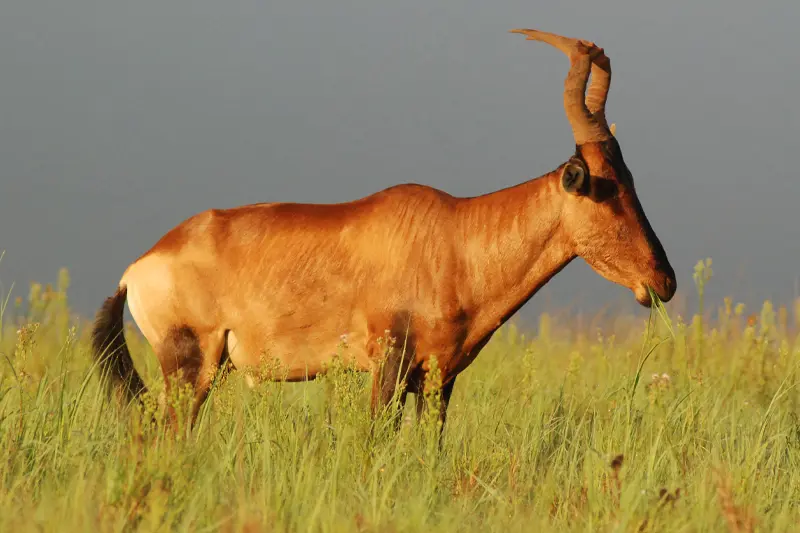
The red hartebeest (Alcelaphus buselaphus caama) is a large, robust antelope standing approximately 1.2-1.3 metres at the shoulder and weighing between 120 and 180 kg. Its body is distinctively proportioned — the shoulders are noticeably higher than the hindquarters, giving the animal a pronounced downward slope towards the tail that is unmistakable in the field. The coat is a rich reddish-brown that darkens to almost black on the face, shoulders, and upper legs. Both sexes carry the characteristic lyre-shaped or bracket-shaped horns, which rise from a heavy, ridged pedicel on top of the skull before curving outward and then hooking sharply backward at the tips.
Red hartebeest are primarily grazers, feeding on short to medium grasses in open plains, savanna, and light woodland. They are gregarious animals, typically found in herds of 10-30 individuals, though larger aggregations can occur in areas with abundant grazing. Territorial bulls defend their territories with vigour, using their horns in ritualised combat and maintaining dung middens as boundary markers. The hartebeest’s eyesight is exceptional — among the sharpest of any African antelope — and they are extremely alert, often the first animals in a mixed herd to detect danger and sound the alarm.
What truly sets the red hartebeest apart, however, is its speed and endurance. Capable of sustaining speeds of 55-65 km/h over extended distances, the hartebeest can outrun nearly every predator in Africa in a prolonged chase. This combination of speed, stamina, and vigilance makes it a far more challenging quarry than its relatively common status might suggest.
Hunting Methods
Rifle Hunting
Rifle hunting for red hartebeest is typically an exercise in open-country marksmanship. Because hartebeest favour open plains and lightly wooded grassland, shots tend to be longer than with bush-dwelling species — 150 to 300 metres is common, and opportunities at 350 metres or beyond are not unusual. A flat-shooting caliber is essential. The .270 Winchester loaded with 130-grain or 150-grain bullets is an excellent choice, offering the trajectory and energy needed for longer-range work. The .30-06 Springfield with 165-grain or 180-grain bullets is equally effective and gives the hunter additional versatility if pursuing larger species on the same safari. A quality scope in the 3-12x or 4-16x range is recommended, and the ability to shoot accurately from sticks or a prone position at 200-plus metres is a genuine asset.
The typical approach involves driving or walking through open habitat until a herd is located, then using terrain features — dry riverbeds, termite mounds, low ridgelines — to close the distance for a shot. Because hartebeest are so alert and favour open ground, the final approach is often the most challenging phase. Your professional hunter will use every available advantage to get you within comfortable range.
Bow Hunting
Bow hunting red hartebeest is a significant challenge, primarily due to the animal’s preference for open terrain and its extraordinary alertness. Waterhole blinds offer the best opportunity, as hartebeest herds visit water regularly, particularly during the dry season. A compound bow with a minimum draw weight of 60 pounds is recommended, with sharp fixed-blade broadheads. Expect shots at 25-40 metres from a well-positioned blind. The hartebeest’s sloping body shape requires careful attention to shot angle — the vitals sit further forward and higher than on most antelope of similar size, and the steep angle of the back can be deceptive.
Spot and Stalk
Spot-and-stalk hunting for red hartebeest is a classic open-country pursuit that tests a hunter’s ability to use terrain and wind to approach one of Africa’s most vigilant animals. The hunt begins with locating a herd from a distance using binoculars or a spotting scope, identifying a mature bull, and planning a route of approach that keeps the hunter hidden and downwind. The key challenge is covering the open ground between you and the hartebeest without being detected. Even a momentary skyline silhouette or a swirling wind eddy can send the entire herd racing across the plains. This style of hunting rewards experience, physical fitness, and the ability to remain patient when the first two or three stalks are blown by alert sentinels.
Where to Hunt
Red hartebeest are found across a wide band of southern African savanna, from Namibia and Botswana through South Africa’s interior provinces. Limpopo Province offers excellent red hartebeest hunting in its mix of open grassland, light woodland, and bushveld plains. Gaspare Spanio Safaris provides red hartebeest hunting South Africa on their 3,000-hectare private game farm, where the open areas and mixed terrain create the kind of habitat in which hartebeest thrive. The property’s managed grasslands support healthy herds of hartebeest alongside other plains game species, giving visiting hunters a diverse and rewarding hunting experience.
The advantage of hunting hartebeest on a private property with managed grazing and controlled burn programmes is the consistently healthy animal populations and reliable trophy quality that these management practices produce.
Best Time to Hunt
Red hartebeest hunting South Africa is productive throughout the dry season, from April through October. The optimal period is May through August, when the cooler winter temperatures make extended walks across open ground more comfortable, the reduced grass height improves visibility, and concentrated water sources bring herds into predictable patterns. June and July are particularly good months, as the dry conditions have begun to bite but the animals are still in good body condition from the summer rains.
September and October can also be productive, though the heat begins to build and the bush becomes very dry and dusty. The rut typically occurs around March and April, when territorial bulls are at their most active and visible. Avoid the summer months of November through February if possible, as tall green grass and scattered water make locating herds more difficult.
Trophy Information
Red hartebeest trophies are measured by horn length, following the front curve of each horn from base to tip. The minimum entry scores for the major record books are:
- SCI (Safari Club International) minimum: 63 inches (combined score of both horns)
- Rowland Ward minimum: 23.5 inches (single longest horn)
An outstanding red hartebeest will carry horns measuring 24 inches or more, with heavy, well-ridged bases and a classic lyre shape. When evaluating a hartebeest in the field, look for horns that extend well above the ears with clearly defined outward splay before curving back. The pedicel — the raised bony platform on the skull from which the horns emerge — should be heavily developed, indicating maturity. Bulls with heavily worn horn tips have been fighting and are typically mature, dominant animals. Your professional hunter will help you assess trophy quality before you take the shot.
Shot Placement
Shot placement on red hartebeest requires an understanding of the animal’s unique body proportions. Because the hartebeest’s shoulders are significantly higher than its hips, and the body slopes downward toward the rear, the vital organs sit further forward and higher in the body than many hunters expect. On a broadside presentation, place your shot in the centre of the shoulder, approximately halfway up the body. This places the bullet through the top of the heart and the centre of both lungs. Aim for the point where an imaginary vertical line drawn through the front leg intersects with a horizontal line drawn halfway between the back and brisket.
A common mistake is aiming too far back and too low, which results in a gut shot on this unusually proportioned animal. If in any doubt, aim slightly forward — hitting the shoulder joint may waste a small amount of meat but will anchor the animal far more reliably than a shot placed too far back. On quartering angles, adjust your aim point to ensure the bullet passes through the forward chest cavity. Avoid rear-quartering shots, as the long body and sloping back create an acute angle that makes it difficult to reach the vitals reliably.
What’s Included
A red hartebeest hunting package with Gaspare Spanio Safaris typically includes:
- Professional hunter and experienced field staff
- Full-board lodge accommodation with all meals and refreshments
- 4×4 hunting vehicles and all in-field transportation
- Field preparation of your trophy — skinning, salting, and initial preservation
- Cold storage and coordination with your chosen taxidermist
- Rifle permit and temporary import assistance
- Airport transfers from Polokwane or Johannesburg
- Laundry service and lodge amenities including beverages
Trophy fees, taxidermy, dipping and packing, shipping, and gratuities are quoted separately. Red hartebeest are priced as standard plains game, making them an affordable and highly rewarding addition to any safari package.
Frequently Asked Questions
Is the red hartebeest a good trophy despite its unusual appearance?
Absolutely. The red hartebeest’s distinctive lyre-shaped horns and unique body proportions make it one of the most recognisable and conversation-starting trophies in any collection. While some hunters are initially put off by the hartebeest’s unconventional silhouette, those who have hunted them invariably rate the experience highly and consider the trophy one of their favourites. The hartebeest has genuine character — it is an animal with personality, and that translates directly into a trophy you will enjoy looking at for years to come.
How fast can a red hartebeest run?
Red hartebeest can sustain speeds of 55-65 km/h over extended distances, making them one of the fastest endurance runners in Africa. Only the tsessebe is considered faster among African antelope. This speed and stamina make the hartebeest very difficult to chase or corner, which is why a well-planned stalk and an accurate first shot are so important.
What caliber is recommended for red hartebeest?
The .270 Winchester and .30-06 Springfield are the ideal calibers for red hartebeest hunting South Africa. Both offer the flat trajectory needed for the longer-range shooting that open-country hunting often demands, while delivering sufficient energy for a clean kill on an animal weighing up to 180 kg. Use quality 130-grain to 180-grain controlled-expansion bullets for best results. Heavier magnums are unnecessary for hartebeest and can make precise shot placement at longer ranges more difficult due to increased recoil.
Can I combine red hartebeest with other species on the same safari?
Red hartebeest are almost always hunted as part of a multi-species plains game safari. While pursuing hartebeest across the open grasslands, you will encounter many other species that share the same habitat — blue wildebeest, impala, zebra, and warthog are all commonly found alongside hartebeest herds. A 5-7 day safari allows ample time to pursue hartebeest and several other species.
Is red hartebeest meat good?
Red hartebeest produces excellent venison — lean, flavourful, and with a fine grain that lends itself to a variety of preparations. The meat is particularly good as steaks, slow-roasted joints, and biltong. Many South African hunters specifically target hartebeest for the quality of the meat, and your lodge will be happy to prepare hartebeest dishes during your stay.
The red hartebeest is one of Africa’s most underrated trophies — an animal that combines genuine hunting challenge with a distinctive and memorable trophy. Contact Gaspare Spanio Safaris to add red hartebeest to your South Africa hunting safari. Our team will help you plan a package that delivers outstanding plains game hunting in the heart of Limpopo. Enquire at gasparespaniosafaris.co.za to get started.
Related Hunts
Hunters who pursue Red Hartebeest also enjoy these species:
- Wildebeest Hunting South Africa
- Tsessebe Hunting South Africa
- Blesbok Hunting South Africa
- Zebra Hunting South Africa
View all huntable species at Gaspare Spanio Safaris.

