


This guide covers shot placement for the ten most commonly hunted plains game species in South Africa. Each section details the anatomy of the vital zone, the preferred shot angles, and the angles to avoid. Whether you are hunting with a rifle or a bow, these fundamentals apply — though bow hunters will find additional notes where placement requirements differ significantly.
All trophy hunting at Gaspare Spanio Safaris is guided by a licensed Professional Hunter who will advise you on shot selection in the field. Use this guide to build your knowledge before the hunt — so when the moment comes, you are ready.
Why Shot Placement Matters More Than Caliber
Hunters spend considerable time choosing calibers, bullets, and rifles. Shot placement deserves at least as much attention. A marginal hit from a magnum rifle causes far more suffering — and a longer, more difficult tracking job — than a well-placed shot from a modest caliber. A bullet through the heart or lungs is instantly incapacitating. A bullet through the gut is not, regardless of caliber.
The vital zone on most plains game species consists of the heart and lungs, located in the lower third of the chest cavity, directly behind the front shoulder. This zone is larger than most hunters expect — on a mature kudu bull, the combined heart-lung zone is roughly the size of a large dinner plate. The challenge is not the size of the target but identifying its precise location on a moving, partially obscured animal, and holding steady enough to hit it.
A few universal principles before we get to species-specific guidance:
- Wait for the right angle. A perfect broadside or quartering-away shot is worth waiting for. Pass on marginal angles — your PH will agree.
- Aim at anatomy, not at the animal generally. Pick a specific spot. “On the shoulder” is not precise enough. Identify the front leg, the bottom of the chest, and the exact point of aim.
- Shoot lower than you think. The most common mistake on plains game is shooting too high. The vital zone sits in the lower portion of the visible chest area.
- Bow hunters: patience is everything. The ideal bow shot is a broadside animal standing still with the near-side leg stepped slightly forward, opening the chest cavity. Never rush a bow shot.
Kudu Shot Placement
The Greater Kudu is South Africa’s most prized trophy and one of the most anatomically challenging animals to hunt. Their deep chest cavity, heavy shoulder structure, and thick hide demand precise placement.
Broadside (Recommended — Rifle)
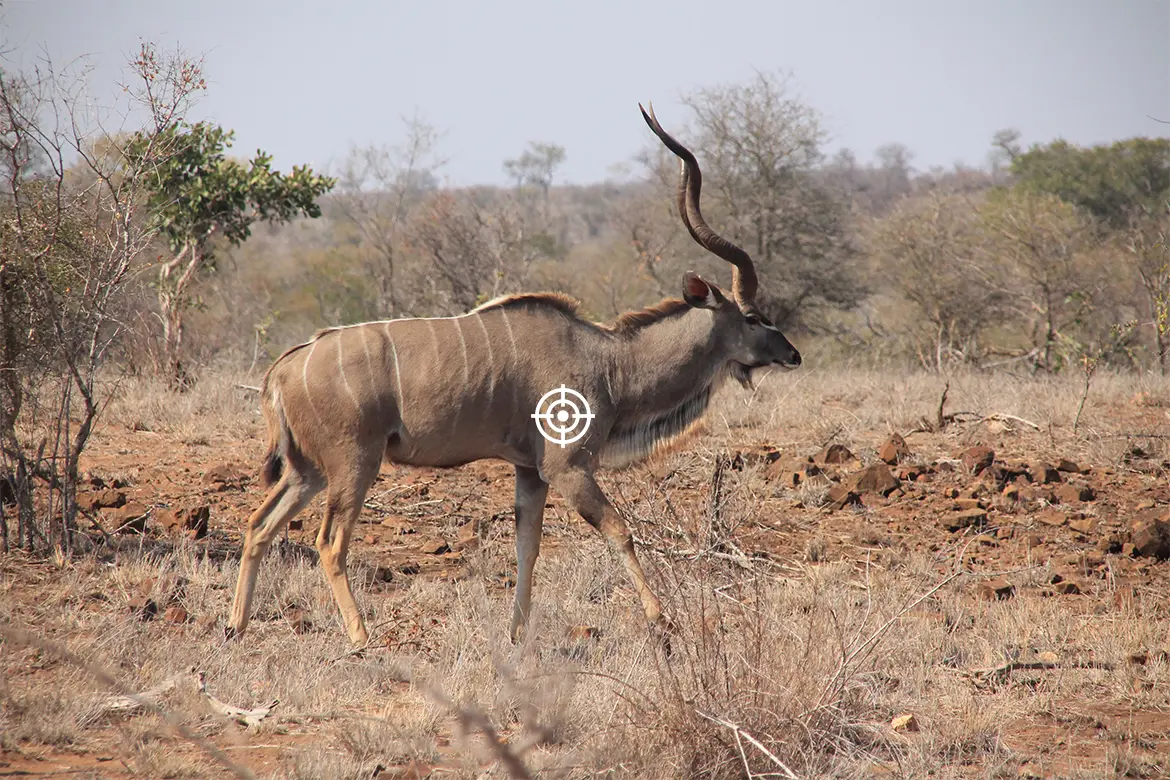
Place the crosshair on the vertical line of the front leg, approximately one-third of the way up from the bottom of the chest. This targets the heart and lower lungs. The most common error is shooting too high — the kudu’s vital zone sits lower in the chest than most hunters expect. Resist the urge to aim at the centre of the visible body mass.
Quartering Away (Highly Effective — Rifle)
Aim for the off-side shoulder. Place the shot behind the last rib on the near side, angling forward so the bullet exits through or just behind the far shoulder. This path traverses the liver and both lungs, and is one of the most effective killing angles on any plains game species.
Bow Placement
The ideal bow shot on kudu is a broadside presentation with the near-side leg stepped forward. Place your pin tight behind the front leg crease, one-third up from the brisket line. A quartering-away angle is acceptable; a frontal or quartering-toward shot is not — the kudu’s heavy shoulder and thick hide will almost certainly result in insufficient penetration. Minimum recommended draw weight: 70 lbs. Wait for the right angle, even if it means passing on the animal entirely.
Planning to hunt kudu? View trophy fees, Rowland Ward minimums, and booking details on our kudu hunting page.
Gemsbok (Oryx) Shot Placement
The gemsbok is one of the most structurally challenging animals to kill quickly. Their heavy shoulder blades, thick hide, and remarkably robust constitution mean that marginal hits rarely result in quick deaths. Precision is essential.
Broadside (Recommended)
Place the shot on the front leg, one-third up from the bottom of the chest. The gemsbok’s heart sits very low in the chest — lower than on most other plains game. Hitting mid-body on a broadside gemsbok will result in a high lung or gut shot. Aim deliberately low and forward.

Quartering Away
Aim for the far-side shoulder, entering behind the last rib on the near side. This is an excellent angle on gemsbok. The bullet path through the body cavity hits multiple organs. Ensure the animal is sufficiently angled away — a minor quartering will not give enough angle to reach the vitals on the far side.
Angles to Avoid
Never take a frontal chest shot on gemsbok unless you are using a caliber of .375 or larger with heavily constructed bullets. The gemsbok’s sternum and front shoulders are extremely robust, and frontal shots frequently result in shoulder hits rather than vital penetration.
View gemsbok trophy fees, season dates, and hunting details on our gemsbok hunting page.
Warthog Shot Placement
Warthog are small, fast, and built much closer to the ground than most hunters realise. They are also tougher than their size suggests and will run considerable distances after a marginal hit. Shot placement must be precise.
Broadside
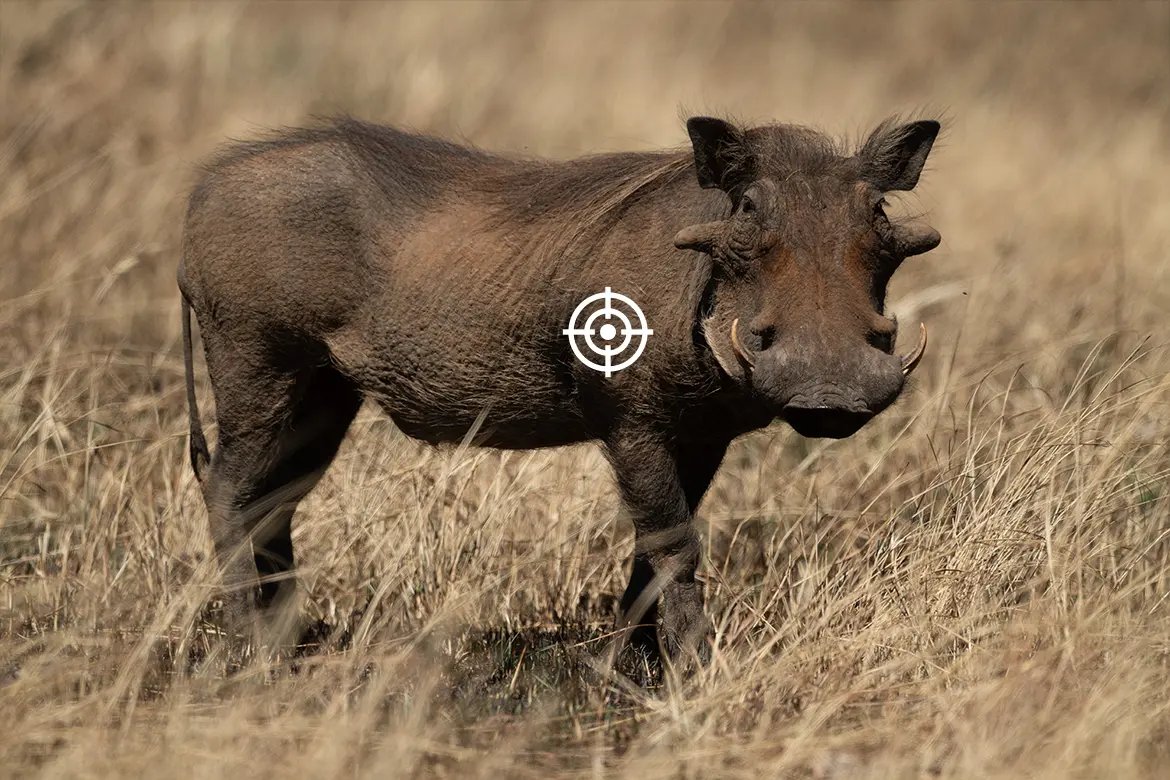
Place the crosshair immediately behind the front leg, roughly in the centre of the body height. On a warthog, this puts the bullet squarely through the lungs and heart. Unlike with larger species, the vital zone on a warthog is approximately at mid-body height — they have proportionally less chest depth relative to their body height than most antelope.
Quartering Away
This is a reliable angle on warthog. Aim to drive the bullet through the body cavity toward the far-side shoulder. The warthog’s compact body means this is a short-distance shot through vital organs.
Frontal Shot
A frontal chest shot on warthog is possible with a rifle, aiming at the centre of the chest between the shoulder points. However, this is a small target on a small animal. A broadside or quartering-away presentation is always preferable.
Bowhunters Note
Warthog are typically hunted from blinds near water, where they present predictable, close-range broadside shots. The vital zone is the same — immediately behind the front leg at mid-body height. Warthog have been known to run hard even after a double-lung hit, so wait at least 30 minutes before following up a bow shot.
See warthog trophy fees and what to expect on a warthog hunt on our warthog hunting page.
Eland Shot Placement
The eland is Africa’s largest antelope, with bulls weighing up to 900 kg. Despite their size, they are surprisingly easy to anchor cleanly with proper shot placement — their vital zone is enormous, and they are not as structurally robust as buffalo or gemsbok.
Broadside
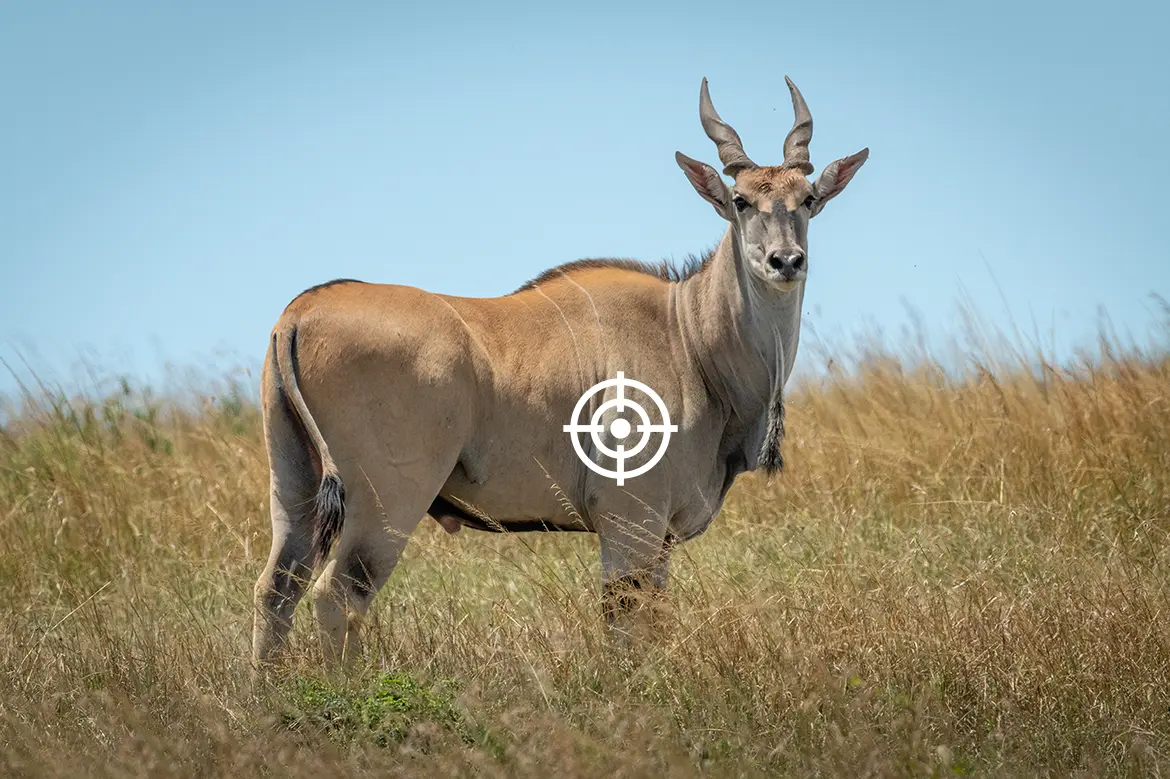
Aim at the front leg line, one-third up from the bottom of the chest. On a mature bull, the heart-lung zone is the size of a large watermelon. There is no excuse for a marginal hit if the angle is correct. Use a caliber appropriate for large game — a minimum of .30-06 with quality 180-grain bullets is the starting point, with larger calibers preferred by many hunters given the eland’s sheer mass.
Quartering Away
Aim to exit through the far-side shoulder. Eland tolerate this angle well and the body cavity is large enough to provide a clear path through vital organs even on a moderate quartering angle.
Shot Distance
Eland are often encountered at longer distances as they move across open ground. Confirm your maximum ethical shooting range before the hunt and decline shots beyond your ability. A wounded eland can cover enormous distances.
Interested in hunting eland? View Rowland Ward minimums and trophy fees on our eland hunting page.
Blesbok Shot Placement
Blesbok are medium-sized antelope and among the most abundant and accessible trophy animals in South Africa. Despite their comparatively modest size, they are tough for their weight and can run considerable distances after a hit.
Broadside
Place the shot on the front leg line, one-third up from the bottom of the chest. This is the same reference point as most plains game species. The blesbok’s heart sits low and forward in the chest cavity. A common error is shooting at the colourful face marking — aim at the body, not the head.

Quartering Away
This is a highly effective angle on blesbok. Their relatively compact body means the bullet traverses the entire chest cavity. Aim behind the last rib to exit through the far shoulder.
See blesbok trophy fees and season information on our blesbok hunting page.
Zebra Shot Placement
Burchell’s Zebra are large, stocky animals with remarkable toughness. They are a favourite for hunters wanting to add an iconic African trophy to their collection. Shot placement must be deliberate — a wounded zebra will run hard and far.
Broadside
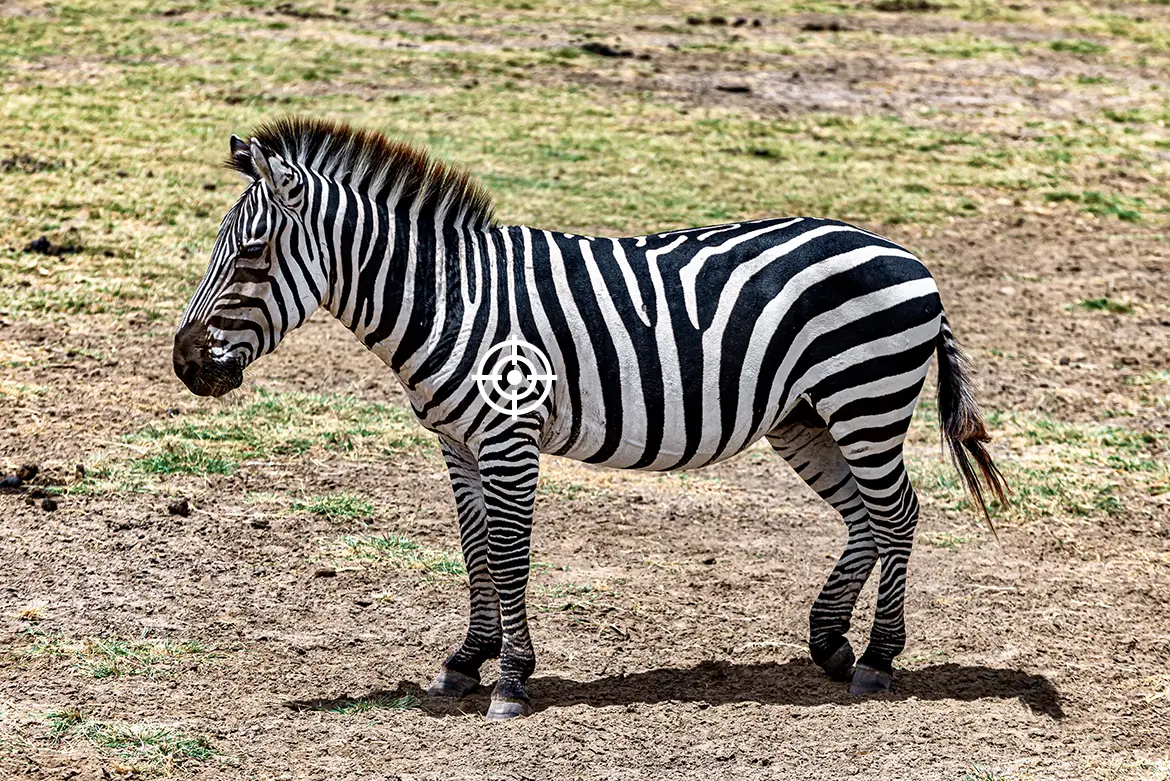
Use the front leg as your vertical reference, aim one-third up from the bottom of the chest. The zebra’s heart sits low in the chest cavity, slightly forward of centre. Many hunters make the mistake of aiming too far back on a zebra — the gut cavity appears shorter than it is because of the zebra’s distinctive striped pattern creating visual confusion. Use the leg, not the body outline, as your reference.
Quartering Away
Aim for the far shoulder, entering behind the last rib on the near side. This is a reliable angle. Ensure sufficient quartering angle before attempting.
Frontal Shot
A frontal chest shot on zebra is possible for experienced hunters using appropriate calibers (.300 Win Mag or larger). Aim at the base of the neck where it meets the chest. This is a small target and is not recommended for most hunters — wait for a broadside presentation.
View zebra trophy fees and what to expect on our zebra hunting page.
Springbok Shot Placement
Springbok are small, fast antelope — South Africa’s national animal. They are commonly the first species taken on a plains game safari and provide excellent practice for shot placement. Despite their small size, they are surprisingly tough.
Broadside
Place the shot on the front leg line, one-third up from the bottom of the chest. Given the springbok’s small body, the vital zone is compact — roughly the size of a side plate. A clean shot requires a steady rest and a calm trigger press. Rifle hunters should consider reducing scope magnification to avoid misjudging shot placement on a small target at moderate range.
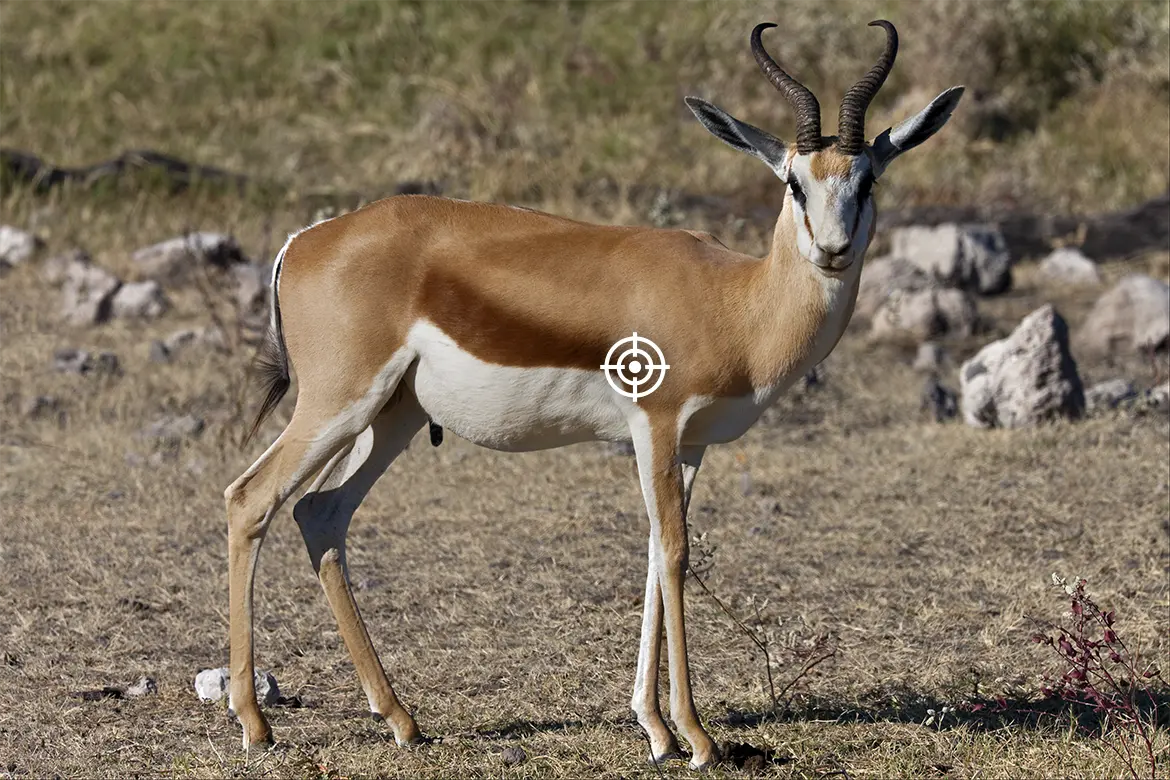
Quartering Away
This is an excellent angle on springbok. Drive the bullet through the chest cavity toward the far shoulder. Given their small size, even a minor quartering angle provides a viable shot path.
See springbok trophy fees and hunting details on our springbok hunting page.
Impala Shot Placement
Impala are often the first trophy taken on a South African plains game safari. They are medium-sized, athletic, and can explode into motion with startling speed. A clean hit requires patience and precise aim.
Where to Shoot an Impala — Broadside
Place the crosshair directly on the front leg, one-third up from the chest floor. This is the heart-lung zone. The impala’s chest is narrow compared to its apparent body size — avoid being drawn to the shoulder itself, which will result in a bone hit and possible non-lethal wound if the bullet deflects.

Quartering Away
Aim to exit through the near-side shoulder, entering behind the last rib. This is a reliable angle on impala. Ensure the animal is sufficiently angled away — a minimal quartering angle requires aiming further forward to ensure vital penetration.
Bowhunters
Impala are commonly taken from blinds near water. The shot is typically taken at 20–35 metres. Pin placement is identical to rifle hunters — behind the front leg crease, low in the chest. The impala’s reflexes are fast; a quiet release is important.
View impala trophy fees and package options on our impala hunting page.
Wildebeest Shot Placement (Blue and Black)
Blue wildebeest are one of the most physically robust plains game species in South Africa. Despite their ungainly appearance, they can absorb significant punishment and run far after a marginal hit. Their anatomy is straightforward, but shot placement must be deliberate. Black wildebeest follow the same shot placement principles.
Broadside
Place the shot on the front leg line, one-third up from the bottom of the chest. The wildebeest’s vital zone is broad, but their large shoulder bones can deflect bullets shot slightly too far forward. Aim just behind the shoulder crease rather than through it. Use a caliber capable of adequate penetration — a minimum of .30-06 with quality bonded ammunition is recommended.
Perfect Shot Placement — Blue Wildebeest
On a perfectly broadside wildebeest, the ideal point of aim is approximately 10 cm behind the front leg, halfway up the body. This places the bullet squarely through the heart and lungs without risking shoulder deflection. Many experienced hunters aim slightly lower than they are accustomed to on other species, as the wildebeest’s apparent body centre is higher than the actual vital zone.

Quartering Away
This is the preferred angle for wildebeest. Aim to exit through the far shoulder. A well-placed quartering-away shot on a wildebeest anchors them quickly even without immediate double-lung penetration, due to the bullet traversing multiple organs.
See blue and black wildebeest trophy fees and hunting information on our wildebeest hunting page.
Waterbuck Shot Placement
Waterbuck are large, heavily built antelope found near rivers, dams, and wetlands. They are one of the tougher plains game species and require adequate caliber selection and precise placement to ensure a clean harvest.
Broadside
Place the shot on the front leg line, one-third up from the chest floor. The waterbuck’s heart sits very low in the chest — lower than most hunters expect on such a large animal. Avoid shooting at the apparent centre of the body mass, which will result in a high lung or gut shot.

Quartering Away
Aim to exit through the near-side shoulder, entering from behind the last rib. This is an effective angle on waterbuck. Use a caliber appropriate for large, tough-bodied game — .308 or .30-06 with premium bonded bullets as a minimum, with larger calibers preferred.
View waterbuck trophy fees and booking details on our waterbuck hunting page.
Cape Buffalo Shot Placement (Dangerous Game)
Cape buffalo are dangerous game requiring a minimum caliber of .375 by South African law. Shot placement is critical not only for ethical reasons but for safety — a wounded buffalo is one of the most dangerous animals in Africa. Your Professional Hunter will be at your shoulder for every shot. Do not take a shot your PH has not confirmed.
Broadside
Place the shot on the front leg line, one-third up from the chest floor. On a buffalo, this targets the heart and lower lungs. Use a heavy, strongly constructed bullet — premium bonded or monolithic solids are strongly recommended. Avoid rapid-expansion bullets that may not penetrate adequately through the buffalo’s heavy hide and shoulder bone.

Frontal Shot (Advanced — Use with Caution)
A frontal chest shot on a facing buffalo is a valid shot for experienced hunters with adequate calibers (.375 H&H or larger). Aim at the centre of the chest at the base of the neck. This angle targets the heart directly. However, a frontal shot on a moving or alert buffalo is extremely dangerous — confirm your PH endorses the shot before taking it.
The Follow-Up
Even a well-placed shot on a buffalo may not result in immediate incapacitation. Your PH will tell you when and whether to shoot again. Never approach a downed buffalo without your PH confirming it is expired — buffalo have killed hunters who approached prematurely.
Interested in Cape buffalo hunting? View dangerous game trophy fees and experience requirements on our Cape buffalo hunting page.
Frequently Asked Questions About Shot Placement in South Africa
What is the most common shot placement mistake in South African hunting?
Shooting too high. The vital zone — heart and lungs — sits in the lower third of the chest cavity on virtually all plains game species. Hunters accustomed to deer or other Northern Hemisphere game often aim at the apparent centre of the body, which results in high lung or even spine hits. Always use the front leg as your vertical reference and aim deliberately low.
Does shot placement differ between rifle and bow hunting?
The target zone is identical. However, bow hunters must be more selective about angles. While a rifle bullet can be driven through a shoulder or at a quartering-toward angle with sufficient penetration, a broadhead relies on cutting through soft tissue. For bow hunters, only broadside and quartering-away shots are acceptable. Never take a frontal or quartering-toward shot with a bow on any of the species listed here.
How long should I wait before tracking after a shot?
For a rifle shot with confirmed vital hit, wait 10 to 15 minutes. For a suspected gut hit, wait a minimum of one hour. For any bow shot, wait at least 30 to 45 minutes, and longer if liver penetration is suspected. Your Professional Hunter will make this call — their experience reading the shot and the animal’s reaction is invaluable. Rushing the follow-up on a liver-hit or gut-shot animal almost always results in pushing it further into thick cover.
Can I rely on my Professional Hunter for shot guidance in the field?
Absolutely. That is partly why having a licensed PH is a legal requirement in South Africa. Your PH will confirm the animal, assess the angle, set up the shooting sticks, and tell you precisely when to shoot. If the angle is not right, they will hold you back. Trust their judgement — it is based on years of experience with these specific animals in this specific terrain. The preparation you do with this guide ensures you arrive with the knowledge to respond correctly the moment your PH gives the signal.
What caliber is recommended for plains game shot placement in South Africa?
For most plains game species (kudu, gemsbok, wildebeest, eland, waterbuck), a minimum of .270 or .308 with quality bonded ammunition is recommended. The .30-06 Springfield with 180-grain premium bullets is the most versatile all-round choice. For dangerous game (buffalo), a .375 H&H is the legal minimum. See our complete caliber guide for species-specific recommendations.
Where do I book a hunting safari in South Africa?
Gaspare Spanio Safaris offers fully guided hunts on a 3,000-hectare private concession in Limpopo for all species listed in this guide. Your Professional Hunter will guide your shot selection in the field. Contact us to discuss species availability, trophy fees, and safari dates for 2026.

