


About the Wildebeest
South Africa is home to two distinct species of wildebeest, each with its own character, habitat, and appeal to hunters. Understanding the differences between the Blue Wildebeest and the Black Wildebeest is essential for planning your hunt.
Blue Wildebeest (Connochaetes taurinus)
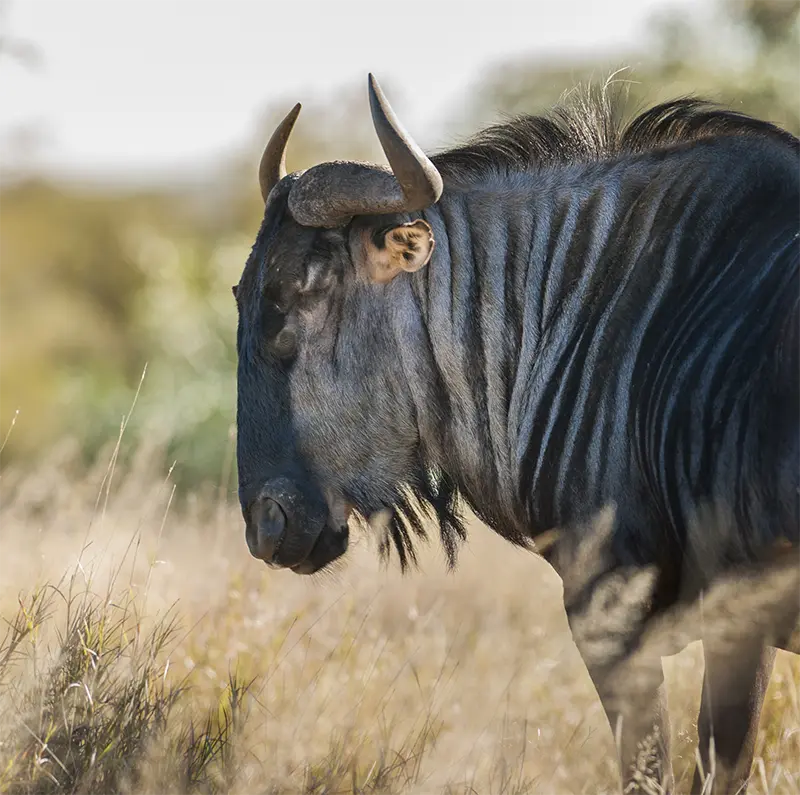
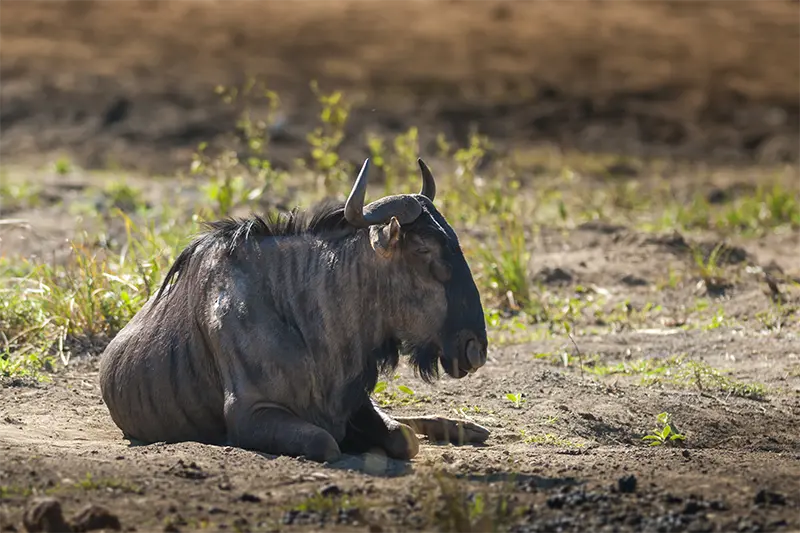
The Blue Wildebeest, also called the Brindled Gnu, is the larger and more widespread of the two species. Mature bulls weigh between 230 and 270 kg (500–600 lbs) and stand roughly 1.5 meters at the shoulder. Their coat is a dark silvery-grey with faint vertical stripes across the flanks, giving them their “brindled” appearance. Both sexes carry horns, but a mature bull’s horns are significantly heavier, with wide bosses that meet or nearly meet at the center of the skull before sweeping outward and upward in a characteristic parenthesis shape.
Blue Wildebeest are gregarious animals, forming herds that range from small bachelor groups to large breeding herds of 30 or more. They are grazers that prefer open bushveld savanna and are commonly found in the Limpopo province, where mixed woodland and grassland provide ideal habitat. Their eyesight is excellent, and they are perpetually alert — a trait that makes stalking them a genuine challenge.
Black Wildebeest (Connochaetes gnou)
The Black Wildebeest, or White-tailed Gnu, is the smaller and arguably more distinctive of the two species. Endemic to South Africa, they weigh between 110 and 160 kg (240–350 lbs) and are characterized by their dark brown to black coat, prominent facial tuft, erect mane, and a long white tail that fans dramatically when they run. Their horns hook sharply forward and then curve upward, giving them a unique profile that is instantly recognizable.
Black Wildebeest are animals of the open highveld grasslands and prefer flat, treeless terrain where they can see predators from a distance. They are fast, nervous, and possess an almost comical tendency to gallop in circles, bucking and snorting, before stopping abruptly to stare back at whatever alarmed them. Do not let their clownish antics fool you — they are tough, resilient animals that can absorb a poorly placed shot and cover remarkable distances before going down.
The “Poor Man’s Buffalo”
Wildebeest have long been nicknamed the “poor man’s buffalo,” and the comparison is well earned. Like the Cape Buffalo, wildebeest are heavy-boned, thick-skinned across the shoulders, and possess a will to survive that is disproportionate to their size. A wounded wildebeest can be genuinely dangerous, particularly a Blue Wildebeest bull at close quarters in thick bush. They have been known to charge when cornered, and their horns are more than capable of inflicting serious injury. Any hunter who dismisses a wildebeest as “just another antelope” is making a mistake they will only make once.
Hunting Methods
The method you choose for your wildebeest hunt will significantly impact the experience. All three approaches below demand respect for the animal’s toughness and awareness.
Rifle Hunting
Rifle hunting is the most popular method for wildebeest hunting in South Africa, and caliber selection matters more here than with most other plains game species. A wildebeest’s shoulder is protected by heavy bone, and the vital organs sit slightly further forward and lower than many hunters expect. The minimum recommended caliber is the .30-06 Springfield loaded with premium 180-grain bonded or monolithic bullets. However, experienced professional hunters overwhelmingly recommend stepping up to a .300 Winchester Magnum, .338 Win Mag, or even a 9.3x62mm. These heavier calibers provide the penetration and energy transfer needed to anchor a wildebeest reliably, particularly when the shot angle is quartering or when the bullet must break through the heavy shoulder boss.
Light, fast-expanding bullets that perform beautifully on impala or springbok are a poor choice for wildebeest. Use premium controlled-expansion projectiles such as the Swift A-Frame, Barnes TSX, or Nosler Partition. A bullet that holds together and penetrates deep is worth far more than one that fragments on impact.
Bow Hunting
Bow hunting wildebeest is one of the most challenging pursuits in African archery. These animals are alert, their hides are thick, and their ribcage is protected by dense bone. A minimum draw weight of 70 lbs is recommended, with heavy arrows in the 450–500 grain range tipped with razor-sharp fixed-blade broadheads. Mechanical broadheads are risky on wildebeest — the tough hide and heavy ribs can prevent full deployment. Shot distances should be kept under 30 meters, and patience from a well-positioned blind near a water source is the most reliable strategy. Even with perfect equipment, expect longer blood trails than with lighter plains game. A second arrow opportunity is rare, so the first shot must count.
Walk and Stalk
Walk and stalk is widely regarded as the most rewarding method for wildebeest hunting. In the Limpopo bushveld, the combination of scattered mopane woodland, dry riverbeds, and open clearings creates terrain that allows a skilled hunter and PH to use cover effectively. The key is to spot the herd at distance, assess the bulls, and plan an approach using terrain, vegetation, and wind to close the gap. Wildebeest herds typically have multiple sets of eyes scanning for danger, so patience is critical. Rushing a stalk is the fastest way to watch a herd disappear over the horizon at 50 km/h. When the bushveld terrain cooperates, closing to within 100–150 meters is achievable, and the shot, when it comes, is deeply satisfying.
Where to Hunt Wildebeest in South Africa
South Africa offers excellent wildebeest hunting across several provinces, with the best destinations depending on which species you are pursuing.
Blue Wildebeest thrive in the warmer, lower-altitude bushveld regions of Limpopo, North West, and Mpumalanga provinces. The mixed woodland savanna of the Limpopo bushveld is classic Blue Wildebeest country — open enough for herds to graze comfortably, but with sufficient cover to make a stalk interesting. Gaspare Spanio Safaris operates on a 3,000-hectare private game farm in Limpopo that holds a healthy, free-roaming population of Blue Wildebeest, offering hunters the authentic bushveld experience without the pressure of overcrowded concessions.
Black Wildebeest, by contrast, are found predominantly on the highveld grasslands of the Free State, Eastern Cape, and parts of KwaZulu-Natal. These open plains demand different hunting strategies — longer shots, fewer stalking opportunities, and a reliance on patience and fieldcraft to close the distance. Some properties in transitional zones between bushveld and highveld hold both species, making a wildebeest “slam” possible on a single safari.
Best Time to Hunt Wildebeest
The optimal window for wildebeest hunting in South Africa runs from April through September, coinciding with the dry winter months. During this period, several factors align in the hunter’s favor.
- Reduced vegetation: Grasses are short and dry, and many trees have shed their leaves, dramatically improving visibility and making it easier to spot and stalk herds across the bushveld.
- Water concentration: As natural water sources dry up, wildebeest become increasingly dependent on permanent waterholes and dams, creating predictable movement patterns that a skilled PH can exploit.
- Comfortable conditions: Daytime temperatures in Limpopo during winter range from 20–28°C (68–82°F), making all-day hunting comfortable. Mornings can be crisp, dropping to 5–10°C, so layered clothing is advisable.
- Calving patterns: Blue Wildebeest in the bushveld typically calve between November and January. By the time the hunting season opens in April, calves are well established and herds have settled into stable social structures with mature bulls holding territories or forming bachelor groups — ideal for selective trophy hunting.
- Rut activity: Blue Wildebeest bulls are most territorial from March through May, when they actively defend breeding territories. Territorial bulls are often more predictable in their movements and can be less wary than bachelor bulls, providing better stalking opportunities.
While wildebeest can technically be hunted year-round on private land in South Africa, the winter months offer a decisively better hunting experience in terms of visibility, animal behavior, and comfort.
Blue & Black Wildebeest Trophy Standards — Rowland Ward & SCI
Judging a wildebeest trophy in the field requires practice and a steady set of binoculars. Here is what to look for and what the record books require.
Blue Wildebeest
The SCI minimum score for Blue Wildebeest is 70 inches, measured by adding the length of both horns along the outside curve plus the width of the bosses. The Rowland Ward minimum is 28½ inches, measured on the longer horn. The Rowland Ward world record stands at 30⅛ inches. A truly exceptional Blue Wildebeest bull will score 80+ SCI (world record: 107⅛ points). Look for heavy, well-developed bosses that are hard and smooth (indicating maturity — typically 7+ years old), with good width at the tips. Boss development is the most important indicator of age and trophy quality. Young bulls have softer, narrower bosses with visible hair between them, while a mature bull’s bosses will be rock-hard and may fully meet in the center.
Black Wildebeest
The SCI minimum score for Black Wildebeest is 72 inches. The Rowland Ward minimum is 22⅜ inches. The Rowland Ward world record stands at 23⅜ inches. A top-class Black Wildebeest will have thick, heavy bosses and horn tips that extend well above the level of the boss. Because their horns hook forward and then curve upward, judging spread and tip height is the key. A mature Black Wildebeest bull of 5–7 years will display the heaviest bosses and most dramatic horn shape.
In both species, do not rush the assessment. Spend time glassing the herd, compare multiple bulls, and trust your professional hunter’s judgment. A wildebeest trophy that looks average at 300 meters may reveal itself as exceptional at 150, and vice versa.
Wildebeest Shot Placement — Where to Aim for a Clean Kill
Shot placement on wildebeest is arguably the single most important factor in a successful hunt. For a visual overview across all species, see our South Africa Shot Placement Guide. More wildebeest are lost to poor shot placement than to any other cause, and the consequences of a badly placed shot — a long, difficult tracking job through thick bush — are something every hunter should strive to avoid.
The Vital Zone
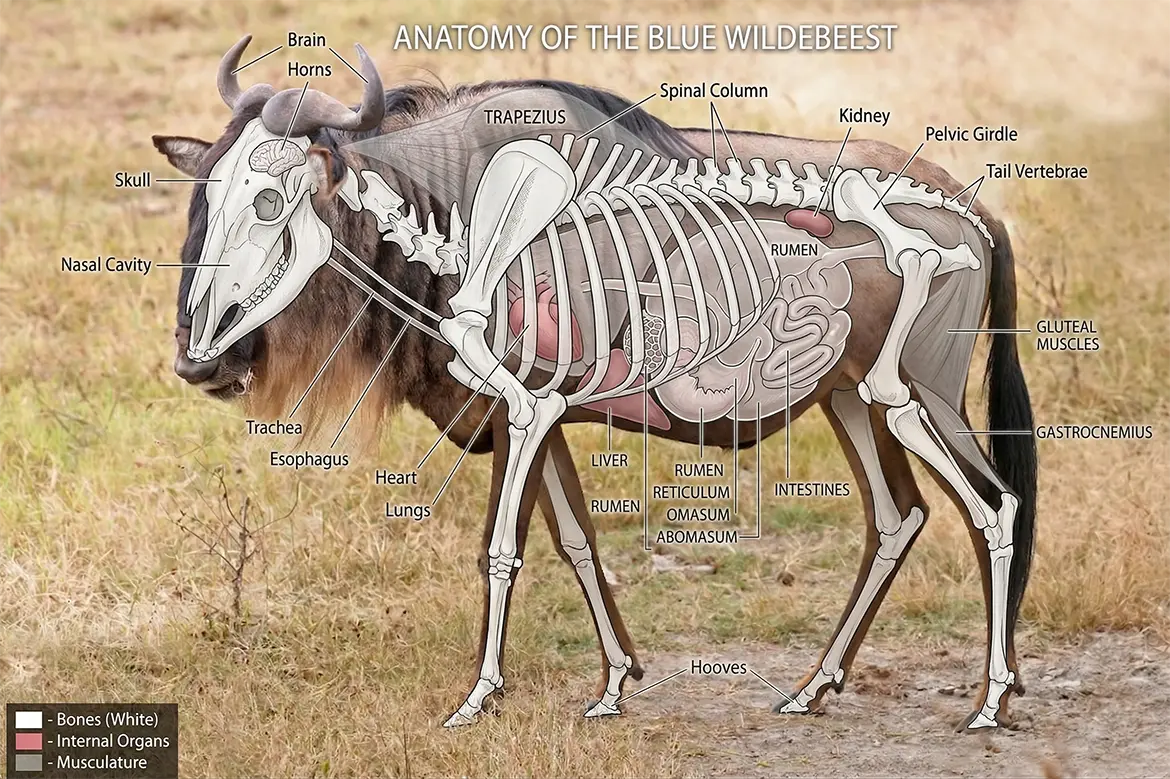
The heart and lungs of a wildebeest sit slightly further forward and lower in the chest cavity than most hunters expect, particularly those accustomed to hunting lighter plains game. On a broadside Blue Wildebeest, the ideal point of aim is directly up the center of the front leg, roughly one-third of the way up from the bottom of the chest. This places the bullet through the heart or the lower lungs, with a high probability of clipping the major blood vessels above the heart.
A common and costly mistake is aiming too far back. A gut-shot wildebeest can travel kilometers before expiring, and tracking one through the Limpopo bush is an experience that will test your patience and your PH’s skill. When in doubt, aim slightly forward rather than slightly back.

Shoulder Shot vs. Heart Shot
Many experienced PHs recommend the high shoulder shot on wildebeest, particularly with heavier calibers. Placing the bullet at the top of the shoulder blade — roughly one-third down from the back line, directly above the front leg — breaks the spine and drops the animal instantly. This shot requires a caliber with enough energy to smash through heavy bone, which is another reason .300 Win Mag and above are preferred. The trade-off is a small margin for error and potential damage to the shoulder cape if you plan to do a shoulder mount.
Blue vs. Black Wildebeest Considerations
Blue Wildebeest are the heavier and tougher of the two species. Their shoulder structure is denser, and their hide is thicker. Shot angles matter more — avoid steep quartering-toward shots unless you are shooting a heavy caliber with deep-penetrating bullets. Black Wildebeest, while lighter, present their own challenge: they are rarely still. Their nervous temperament means you may have a narrower window for a shot, and shooting at a moving or turning animal is a recipe for a wounding shot. Wait for the broadside presentation, confirm your aiming point, and squeeze the trigger only when you are confident.
With both species, be prepared for a follow-up shot. Even a perfectly placed first bullet may not drop a wildebeest immediately, and a quick, accurate second shot can prevent a long tracking exercise. Keep your rifle loaded and your eye on the animal after the first shot.
What’s Included in Your Wildebeest Hunt
At Gaspare Spanio Safaris, wildebeest hunts are conducted on our private 3,000-hectare game farm in Limpopo, ensuring an exclusive, unpressured experience with free-roaming herds.
- Blue Wildebeest trophy fee: See our South Africa Trophy Price List for current pricing
- Black Wildebeest trophy fee: Available on request, subject to availability
- Daily rates include: Professional hunter (1-on-1), accommodation in comfortable lodge facilities, all meals and beverages, hunting vehicle and field preparation, and trophy handling to the taxidermist
- Combo opportunities: Wildebeest pair exceptionally well with other Limpopo bushveld species. Popular combinations include Blue Wildebeest with Kudu, Impala, Warthog, and Zebra for a well-rounded plains game safari of 5–7 days
- Bow hunting packages: Dedicated bow hunting blinds at active waterholes are available for archery hunters pursuing wildebeest
A typical wildebeest hunt requires 2–3 hunting days, though we recommend building it into a longer safari to take advantage of the exceptional variety of species available on the property.
Frequently Asked Questions
How tough are wildebeest compared to other plains game?
Wildebeest are among the toughest plains game animals in Africa. Their heavy bone structure, thick hide, and sheer determination to survive mean they can absorb a marginal hit and travel long distances. They are routinely compared to Cape Buffalo in terms of tenacity relative to their size. Use enough gun, place your shot carefully, and always be ready for a follow-up.
What is the minimum caliber for wildebeest hunting?
The absolute minimum is .30-06 Springfield with 180-grain premium bonded or monolithic bullets. However, most professional hunters strongly recommend .300 Winchester Magnum or larger. Lighter calibers such as .270 or .308 can work with perfect shot placement, but they leave very little margin for error on an animal this tough. When in doubt, go heavier.
Can I hunt both Blue and Black Wildebeest on the same safari?
Yes, it is possible to hunt both species on a single South African safari, though it may require hunting in different areas since the two species occupy different habitats. Blue Wildebeest are hunted in the bushveld, while Black Wildebeest are found on the open highveld. Browse our hunting packages for multi-species options, or discuss your goals with us during the planning phase so the logistics can be arranged.
What is the average shot distance for wildebeest?
In the Limpopo bushveld, most Blue Wildebeest are taken at between 80 and 200 meters via walk and stalk. Black Wildebeest on open highveld may require shots of 200–300 meters due to the lack of cover. Practice at realistic distances before your safari, and know your maximum effective range with your chosen rifle and ammunition.
Do I need to worry about wildebeest charging?
A wounded wildebeest, particularly a Blue Wildebeest bull, can be aggressive when cornered in thick bush. While outright charges are uncommon, they do occur, and a wildebeest coming at you through the mopane scrub is a serious situation. This is another reason why adequate caliber and shot placement are non-negotiable. Your professional hunter will always be backing you up, but the goal is to never need that backup.
What is the best trophy preparation for a wildebeest?
The most popular mount options are a shoulder mount or a European skull mount. For a shoulder mount, instruct your taxidermist on the desired pose before the hunt so your PH can make the cape cuts accordingly. Wildebeest skulls with their distinctive horn formations also make striking European mounts. Dip-and-pack services are available to prepare and ship your trophy to your home country, and your PH will coordinate all logistics from the field to the taxidermist.
Related Hunts
Hunters who pursue Wildebeest also enjoy these species:
- Zebra Hunting South Africa
- Red Hartebeest Hunting South Africa
- Golden Wildebeest Hunting South Africa
- Gemsbok Hunting South Africa
View all huntable species at Gaspare Spanio Safaris.
Ready to experience the thrill of wildebeest hunting in South Africa? Contact Gaspare Spanio Safaris to start planning your Limpopo bushveld safari. Whether you are after a heavy-bossed Blue Wildebeest bull or looking to build a complete plains game package, our team will tailor a hunt to match your goals, your timeline, and your sense of adventure. Get in touch today to secure your dates.

