


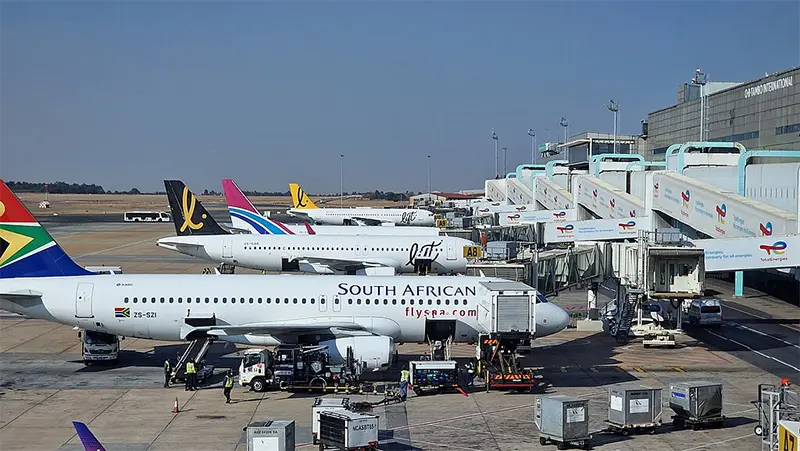
Flight Options from Denmark
Copenhagen (CPH) to Johannesburg O.R. Tambo International Airport (JNB) is the standard route for Scandinavian hunters heading to South Africa. There are no direct flights, but several excellent one-stop connections keep total travel time between 12 and 16 hours depending on the layover.
- KLM via Amsterdam (AMS) — The most popular choice for Danish travelers. Short first leg (roughly 1 hour 40 minutes), then a direct overnight flight to JNB. KLM has a well-established firearms acceptance policy and Amsterdam Schiphol handles transit firearms efficiently.
- Lufthansa via Frankfurt (FRA) — Another reliable European routing. Frankfurt is a major hub with good firearm-handling procedures. Total travel time approximately 13–14 hours.
- Qatar Airways via Doha (DOH) — A premium option with newer aircraft and excellent service. Slightly longer routing (15–16 hours total), but competitive pricing, especially in shoulder season.
- Emirates via Dubai (DXB) — Similar travel time to the Qatar routing. Both Middle Eastern carriers offer generous baggage allowances, though firearm policies require advance coordination.
Booking tips: Book flights 4–6 months in advance for the best fares. Peak hunting season (May–September, South Africa’s dry winter) coincides with European summer, so demand is high. Return flights on Sundays tend to be more expensive. Expect economy fares between DKK 5,000 and DKK 9,000 depending on season, and always declare your firearm as special baggage at the time of booking — not at check-in. Airlines require 24–72 hours advance notice for firearms, and some routes have limited firearm slots per flight.
Bringing Your Rifle to South Africa
Traveling with a hunting rifle from Denmark to South Africa is entirely legal and straightforward — provided you have the correct paperwork in order before you leave home.
Documents Required
- SAPS 520 form — This is the South African Police Service temporary firearm import permit. It must be completed in advance and presented to the SAPS Firearm Office at O.R. Tambo airport upon arrival. Download the form from the SAPS website or request it from your outfitter.
- Danish jagttegn (hunting license) — Your valid Danish hunting license proving you are a licensed hunter.
- Våbenpas (Danish firearms passport) — Issued by Danish police, this document lists the specific firearm(s) you are authorized to carry across borders.
- European Firearms Pass (EFP) — Required for transit through EU countries (e.g., the Netherlands or Germany). Apply through your local Danish police district well in advance.
- Invitation letter from outfitter — Gaspare Spanio Safaris provides a formal letter confirming your booking and the species you will hunt, which supports your SAPS application.
Ammunition and Case Requirements
South Africa allows you to import up to 200 rounds of ammunition for the caliber(s) listed on your SAPS 520 permit. Ammunition must be packed in the locked hard case with the firearm — never in carry-on luggage. Your rifle case must be a purpose-built, lockable hard case (e.g., Pelican, Americase, or similar). Bolts may need to be removed and stored separately depending on the airline. Check your specific carrier’s policy.
Transit Country Rules
If transiting through Amsterdam, your firearm remains in bonded luggage and does not need to clear Dutch customs, provided you hold a valid European Firearms Pass. Frankfurt follows similar EU transit rules. For Doha or Dubai transits, firearms stay in airline custody throughout — no additional permits are required, but advance notification to the airline is mandatory.
Alternative: Rent from the outfitter. If the paperwork feels daunting or you prefer to travel light, Gaspare Spanio Safaris can arrange quality hunting rifles for you on the farm. This eliminates all firearm transport logistics entirely.
Danish-Specific Requirements
Beyond the standard travel documents, Danish hunters should address the following before departure:
- Jagttegn — Must be valid for the year of travel. Renew through Miljøstyrelsen if needed.
- Våbenpas — Apply through your local politikreds at least 4–6 weeks before departure. Specify each firearm you intend to bring by serial number and caliber.
- EU Firearms Pass — Necessary for transiting EU member states. Apply at the same time as your våbenpas.
- Export permit — Contact Danish police (Politiets Administrative Center) to confirm whether your specific caliber or firearm type requires an additional export authorization.
- Travel insurance — Standard Danish rejseforsikring does not always cover hunting activities. Verify that your policy explicitly covers hunting accidents, firearm liability, and medical evacuation from a remote area. Gouda, Europæiske ERV, and specialty providers like Dansk Jagtforsikring offer suitable policies.
- Vaccinations — Statens Serum Institut (SSI) recommends ensuring your routine vaccinations are current, including hepatitis A and typhoid for travel to South Africa. Yellow fever vaccination is only required if transiting through an endemic country.
- Malaria prophylaxis — Limpopo is classified as a low-to-moderate malaria risk area, primarily during the wet summer months (October–March). Consult your travel health clinic about Malarone or doxycycline. During the dry winter hunting season (May–September), risk is significantly reduced but precautions are still recommended.
What Gaspare Spanio Safaris Takes Care Of
One of the great advantages of booking with an established outfitter is the amount of logistics they handle on your behalf. Gaspare Spanio Safaris provides a comprehensive, full-service safari experience:
- Airport pickup at JNB — A representative meets you at O.R. Tambo International after you clear customs and the SAPS firearm desk.
- Transport to the farm — Comfortable vehicle transfer from Johannesburg to the private game farm in Limpopo (approximately 3–4 hours).
- SAPS processing assistance — Guidance and support with the firearm import process at the airport, ensuring your paperwork clears smoothly.
- Full lodge accommodation — Comfortable lodge with en-suite rooms, hearty meals, refreshments, and laundry service throughout your stay.
- Professional Hunter (PH) and tracker — An experienced, licensed PH guides every hunt, accompanied by skilled local trackers who know the farm intimately.
- Return transport to JNB — Transfer back to the airport on your departure day, with time built in for the SAPS firearm export process.
- Taxidermy coordination — Assistance arranging dip-and-pack or full taxidermy mounts through trusted local taxidermists, plus guidance on shipping trophies to Denmark.
Packing Checklist
Documents
- Valid passport (minimum 6 months validity and 2 blank pages on arrival)
- Jagttegn (Danish hunting license)
- Våbenpas (firearms passport)
- European Firearms Pass
- Completed SAPS 520 form (print multiple copies)
- Flight tickets and booking confirmations
- Travel and hunting insurance documents
- Credit cards and some South African Rand (ZAR) for tips and incidentals
- Outfitter invitation letter
Hunting Clothing
- Neutral earth-tone colors — khaki, olive, brown, tan. Important: Military-pattern camouflage clothing is illegal to wear in South Africa. This is strictly enforced.
- Layering system for temperatures ranging from 5°C at dawn to 30°C at midday
- Fleece or softshell jacket for cold mornings on the vehicle
- Sturdy, broken-in hiking boots (ankle support recommended for rocky terrain)
- Wide-brim hat for sun protection
- Gaiters (optional, useful in thick bush)
Hunting Gear
- Rifle in an approved lockable hard case
- Scope (properly zeroed before departure — you will re-zero on arrival)
- Ear protection (electronic muffs recommended)
- Rangefinder
- Quality hunting knife
- Daypack for carrying water, sunscreen, and personal items in the field
- Ammunition (up to 200 rounds, packed in the locked hard case)
Personal Items
- SPF 50+ sunscreen (the Limpopo sun is fierce, even in winter)
- DEET-based insect repellent
- Polarized sunglasses
- Camera with a decent zoom lens
- Powerbank for charging devices in the field
- South Africa Type M power adapter (the unique three-prong round-pin plug)
- Headlamp or small flashlight
- Malaria tablets (if prescribed)
- Personal medications and a basic first-aid kit

What to Expect Day by Day
Day 1 — Arrival: After landing at JNB and clearing the SAPS firearm desk, you are met by the Gaspare Spanio Safaris team and driven to the farm in Limpopo. On arrival, you settle into the lodge, zero your rifle on the range, and sit down to a welcome dinner with your Professional Hunter to discuss species priorities, hunting style, and the week ahead.
Days 2–6 — Hunting: A typical hunting day follows the rhythm of the African bush. You wake around 5:00 AM to coffee and rusks, then head out for the morning hunt when game is most active and temperatures are pleasant. By mid-morning, you return to the lodge for a full brunch. The midday hours — when the heat peaks — are for resting, swimming, or reviewing trail camera footage. Around 3:00 PM, the afternoon hunt begins, often continuing until the golden hour before sunset. The day ends with a sundowner drink overlooking the bushveld, followed by a hearty dinner where the day’s stories are shared around the fire. Typical species pursued include kudu, impala, blue wildebeest, warthog, and many more — see the full hunting species list.
Last Day — Departure: After a final breakfast, your trophies are confirmed with the skinning shed, and you are transferred back to Johannesburg for your return flight. The SAPS firearm export process at JNB is handled before check-in.
Trophy Shipping to Denmark
Getting your trophies home requires patience, but the process is well-established. After your hunt, trophies go to a professional taxidermist for preparation. The most common option for international hunters is dip and pack — the hides and skulls are treated, dried, dipped in a government-approved insecticide solution, and crated for air or sea freight.
- Shipping time: Expect 6–12 months from hunt to delivery, depending on taxidermy backlog, shipping method (sea freight is slower but significantly cheaper than air), and customs processing.
- CITES permits: Most plains game species do not require CITES permits. However, species listed under CITES appendices (such as certain crocodile or leopard trophies) require export permits from South Africa and import permits for the EU. Your outfitter and taxidermist will advise which species apply.
- EU customs: Upon arrival in Denmark, trophies clear through EU veterinary and customs inspection. Ensure all dip-and-pack certificates and phytosanitary documentation are included with the shipment.
- Recommended approach: Gaspare Spanio Safaris works with established shipping agents who specialize in trophy freight to Scandinavia and the EU. Let the professionals handle the logistics — it saves considerable headache.
Budget Planning
A hunting safari is a significant investment, and transparent budgeting helps you plan without surprises. Here is what to expect for a typical 7-day plains game safari:
Cost Breakdown
- Daily rate: Covers accommodation, meals, drinks, PH and tracker services, vehicle and fuel, and laundry. See the current hunting price list for exact daily rates.
- Trophy fees: Charged per animal harvested, according to the trophy price list. You only pay for what you take. Prices vary significantly by species — impala are affordable, while kudu and sable command higher fees.
- Flights (CPH–JNB return): DKK 5,000–9,000 depending on season and airline.
- Travel and hunting insurance: DKK 500–1,500 for a week-long policy with hunting coverage.
- Taxidermy and shipping: Highly variable — from a few thousand DKK for dip-and-pack of a couple of shoulder mounts to significantly more for full mounts or multiple trophies. Budget DKK 5,000–20,000+ depending on your harvest.
What Is Included vs. Excluded
The daily rate typically includes all accommodation, meals, beverages, PH and tracker, hunting vehicle, airport transfers, and SAPS assistance. Excluded items generally include trophy fees, flights, travel insurance, gratuities, taxidermy, trophy shipping, and any additional sightseeing or non-hunting activities.
A realistic total budget for a 7-day hunt with 4–5 plains game trophies, including flights and shipping, falls in the range of DKK 35,000–70,000 depending on species selection and taxidermy preferences. Contact the outfitter for a personalized quote.
Frequently Asked Questions
Do I need a South African hunting license?
No. As a foreign hunter accompanied by a licensed Professional Hunter, you do not need a separate South African hunting license. Your PH’s license covers the hunt. You do need your Danish jagttegn and the SAPS 520 temporary firearm permit if bringing your own rifle.
Should I bring my own rifle or rent one?
Both options work well. Bringing your own rifle means hunting with a familiar weapon you have already zeroed and practiced with. Renting from the outfitter eliminates all firearm transport paperwork and airline coordination. For rifle hunting, popular calibers like .308 Win or .30-06 are readily available. If you are interested in bow hunting, bring your own bow as fit and familiarity are critical.
Is South Africa safe for travelers?
South Africa is a well-established hunting tourism destination. On a private game farm in Limpopo, you are far from urban crime concerns. The farm environment is secure, and you are accompanied by your PH at all times in the field. Common-sense precautions at the airport and in Johannesburg apply as they would in any major city worldwide.
What happens if my flight is delayed?
Gaspare Spanio Safaris monitors flight arrivals and adjusts pickup times accordingly. If you are significantly delayed, contact the outfitter via WhatsApp or phone — the details are provided in your booking confirmation. Overnight accommodation near the airport can be arranged if necessary.
Can my family join without hunting?
Absolutely. Non-hunting guests are welcome at the lodge and can enjoy game drives, bird watching, photography, swimming, and the general beauty of the Limpopo bushveld. It is an excellent family experience, and many hunters bring partners or older children along.
When is the best season to hunt?
The South African hunting season runs from approximately March to October. The dry winter months of May through August are considered the prime period — vegetation thins out, animals concentrate around water, and temperatures are comfortable. Early season (March–April) offers lush green landscapes and dramatic skies but thicker bush. See the full species and season overview for details.
Does Gaspare speak Danish or Scandinavian languages?
Communication at the lodge is in English, which is the primary language of the operation. Most Danish hunters are comfortable in English. If language is a concern, the team is experienced in hosting Scandinavian guests and communication has never been an issue.
What vaccinations do I need?
No vaccinations are legally required for entry to South Africa from Denmark (unless transiting through a yellow fever zone). However, Statens Serum Institut recommends hepatitis A, typhoid, and ensuring your tetanus and diphtheria boosters are current. Malaria prophylaxis is recommended for the Limpopo region — consult your travel health clinic at least 4 weeks before departure.
Ready to Book Your Safari?
A hunting safari in the South African bushveld is the kind of experience that stays with you for a lifetime — the dawn chorus over the Limpopo thornveld, the patience of the stalk, the adrenaline of the shot, and the camaraderie around the fire at the end of a long day. Gaspare Spanio Safaris has built a reputation for personal, professional, and unforgettable safari experiences on their private game farm. Whether it is your first African hunt or your tenth, the team is ready to make it exceptional. Get in touch to start planning your trip.

