


About the Animal
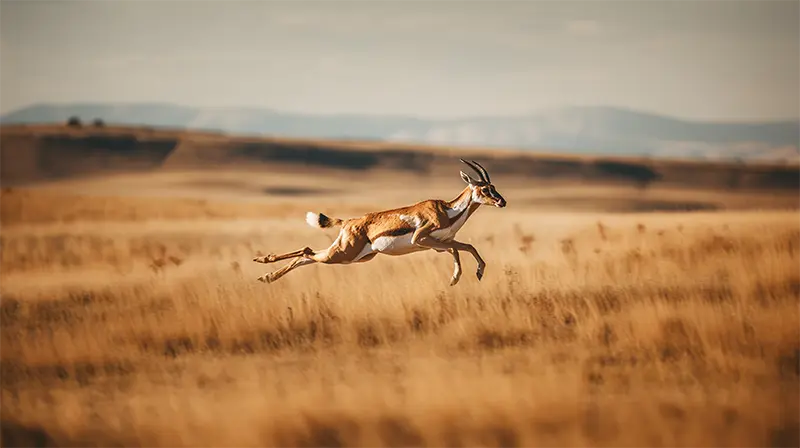
The springbok (Antidorcas marsupialis) is a medium-sized gazelle standing 70 to 87 cm at the shoulder and weighing between 30 and 50 kg. The common springbok displays a striking tricolour pattern — cinnamon-brown upper body, white underparts, and a dark brown lateral stripe separating the two. A distinctive fold of white hair along the back, known as the dorsal crest or “pronk” fan, is erected during the animal’s famous stiff-legged leaping display, from which it gets its name.
Both rams and ewes carry lyre-shaped horns, though the ram’s horns are noticeably thicker and more heavily ridged, with a wider spread. Springbok are incredibly alert, with exceptional eyesight and a nervous disposition that makes approaching within rifle range a genuine challenge on open ground.
Beyond the common variant, selective breeding and natural colour mutations have produced the black springbok (dark chocolate-brown to near-black body), white springbok (predominantly white with faint markings), and copper springbok (rich reddish-copper body without the lateral stripe). All four variants are available at quality hunting concessions in Limpopo and make for a spectacular “springbok slam” — taking one of each colour in a single safari.
Springbok are mixed feeders, both grazing and browsing depending on seasonal availability. They are highly gregarious, often found in herds ranging from a dozen to several hundred individuals. Their social structure revolves around territorial rams that control small territories during the breeding season and bachelor herds of younger or displaced males.
Hunting Methods
Rifle Hunting
Rifle hunting is the most common method for taking springbok. The hunt typically begins with a vehicle-assisted approach, driving slowly along the boundaries of open areas where springbok feed in the early morning and late afternoon. Once a suitable ram has been identified and evaluated through binoculars, the stalk begins on foot. Springbok frequent open terrain, so the stalk often involves using low scrub, termite mounds, and subtle undulations in the ground for concealment. Shots can range from 100 to 300 metres, and the ability to shoot accurately from sticks at longer distances is a significant advantage.
The ideal calibers for springbok are in the .243 Winchester to .270 Winchester range. These flat-shooting, moderate-recoil cartridges deliver enough energy for a clean kill without excessive meat damage on this relatively small animal. The .25-06 Remington is a particularly popular choice. Heavier calibers such as the .308 Winchester and .30-06 can certainly be used, but select lighter, controlled-expansion bullets to avoid destroying the cape. Use premium bullets that expand reliably at the velocities and distances typical of springbok hunting.
Bow Hunting
Bow hunting springbok is challenging due to their small size, alert nature, and preference for open habitat. The most effective approach is hunting from a blind positioned near a water point, particularly during the dry winter months. A minimum draw weight of 50 pounds is adequate given the springbok’s light body, but accuracy is paramount — the vital zone is small. Use fixed-blade broadheads of at least 100 grains and aim for tight, mechanical accuracy at distances of 20 to 35 metres. Patience is essential, as springbok are skittish at water and may approach and retreat several times before committing to drink.
Walk and Stalk
Walk-and-stalk hunting for springbok is a classic and highly rewarding method. The terrain at Gaspare Spanio Safaris provides a mix of open grassland and scattered thorn bush that allows for creative stalking. Your professional hunter will read the wind, identify feeding patterns, and use available cover to manoeuvre you into position. Because springbok are constantly moving while feeding, timing your approach to coincide with the herd’s direction of travel is crucial. This method demands patience, good field glasses, and the willingness to abort a stalk and start over when the wind shifts or the animals change direction.

Where to Hunt
While springbok are most commonly associated with the open Karoo and Free State grasslands, thriving populations exist throughout Limpopo Province in areas with suitable open habitat. Gaspare Spanio Safaris maintains healthy springbok populations across the property’s open plains and grassland areas. The advantage of hunting springbok in Limpopo is the opportunity to combine this species with the many other bushveld plains game species available on the same concession — kudu, impala, blue wildebeest, gemsbok, warthog, zebra, and more. This makes Limpopo an ideal destination for hunters seeking a diverse, multi-species safari without needing to travel between properties.
Best Time to Hunt
Springbok can be hunted throughout the year in Limpopo, but the dry winter months from May to September offer the best conditions. Reduced vegetation makes spotting and approaching springbok considerably easier, and cooler temperatures keep both hunter and animal more active during the day. The rut typically occurs in late autumn (April to May), during which rams become more territorial and less cautious, occasionally offering easier stalking opportunities. The breeding season can also produce dramatic displays of pronking, making for a visually spectacular hunting experience. Summer hunts from November to March are possible but more challenging due to tall grass and dense foliage.
What Is a Trophy Springbok? — Rowland Ward & SCI Standards
Springbok trophies are assessed primarily on horn length, base circumference, and the spread or curve of the horns. A mature ram will have thick, deeply ridged horns that hook inward at the tips with a noticeable gap between them — the so-called “bridge” — that gives the horns their characteristic lyre shape.
- SCI minimum entry score: 49 inches (combined measurement of both horns including circumference bases)
- Rowland Ward minimum entry: 14 inches (single longest horn, measured around the curve)
- Rowland Ward world record: 16⅜ inches — taken in South Africa
- SCI world record: 60⅝ points
A good representative common springbok ram will carry horns of 12 to 14 inches. Animals exceeding 15 inches are exceptional trophies. Colour variants — black, white, and copper — are scored using the same system, though their horn measurements tend to be slightly shorter than common springbok due to selective breeding priorities. Your professional hunter will assess horn length relative to the animal’s ear length (approximately 6 inches) to estimate trophy quality in the field.
Current springbok trophy fees — for all four colour variants — are listed on our South Africa Trophy Price List. Springbok represent exceptional value for their visual appeal.
Springbok Shot Placement — Small Vital Zone
Precise shot placement on springbok is critical due to their small body size. For a visual overview across all species, see our South Africa Shot Placement Guide. The vital area — heart and lungs — is compact, and a shot placed even slightly too far back or too high can result in a wounded animal that runs a considerable distance before expiring.
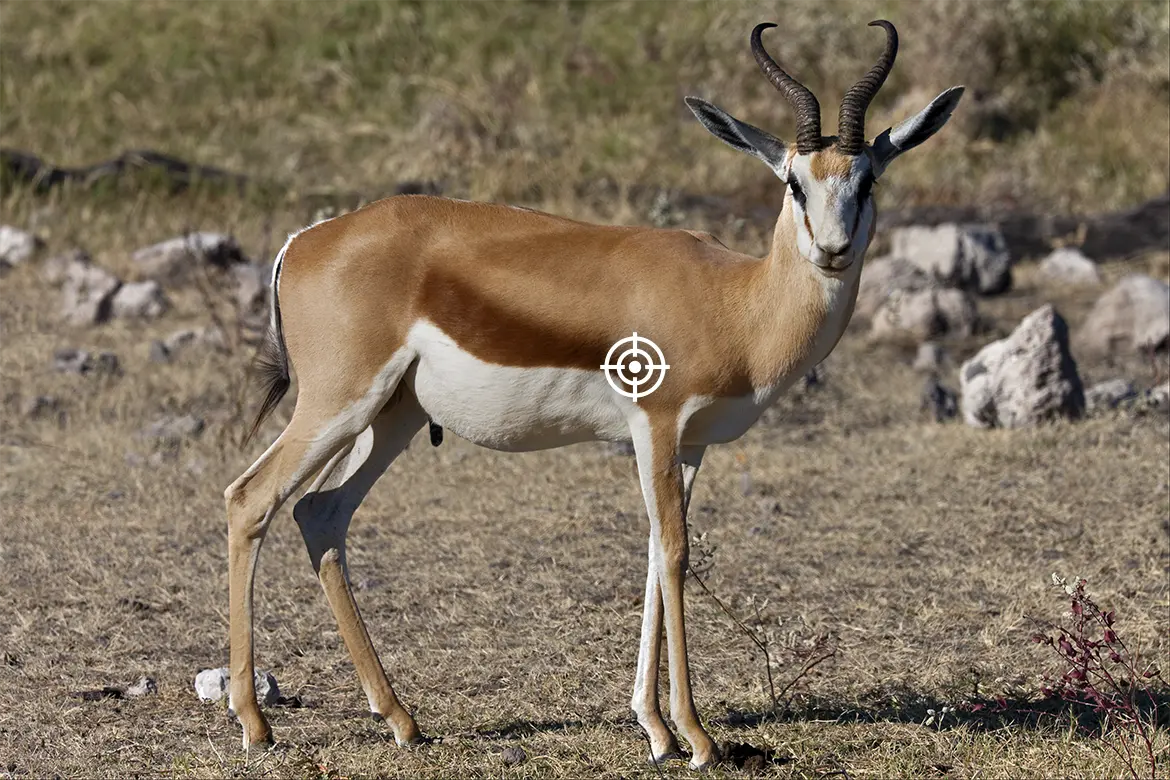
For a broadside shot, place the crosshairs directly on the point of the shoulder, roughly one-third of the way up from the bottom of the chest. This targets the heart and both lungs. The high shoulder shot, placed at the top of the shoulder blade, is effective for anchoring springbok on the spot but requires excellent accuracy given the small target area.

On a quartering-away shot, aim for the opposite shoulder, placing the bullet through the rib cage and into the vitals. Avoid frontal and quartering-towards shots — the springbok’s narrow chest and small vital zone make these angles unreliable. If the animal is facing you head-on, wait for it to turn. Your professional hunter will help you judge the angle and distance before you shoot.
What’s Included
A springbok hunting package with Gaspare Spanio Safaris typically includes:
- Services of a professional hunter and skilled trackers
- Lodge accommodation with en-suite facilities on the private game farm
- Three meals daily plus refreshments and beverages in the field
- Hunting vehicle, shooting sticks, and all field equipment
- Field preparation and skinning of trophies, salting and delivery to taxidermist
- Daily laundry service
- Airport transfers from Polokwane or Johannesburg by arrangement
Trophy fees for each colour variant are charged separately. Taxidermy, dipping and packing, and export permits are additional. A “springbok slam” — all four colour variants — can be arranged as part of a multi-day package. Browse our hunting packages or contact us for current pricing and availability.
Frequently Asked Questions
What is a springbok slam?
A springbok slam involves taking one of each of the four colour variants — common, black, white, and copper — during a single safari. It is a popular goal among collectors and makes for a stunning display of mounted trophies. At Gaspare Spanio Safaris, all four variants are available, and a slam can typically be completed within three to four hunting days, depending on conditions.
Is springbok hunting suitable for a first-time African hunter?
Springbok hunting South Africa is an excellent introduction to African plains game hunting. The animals are abundant, the hunt is active and engaging, and the trophy fees are among the most affordable of all African species. Combined with the relatively light caliber requirements, springbok make an ideal first African trophy.
How fast can a springbok run?
Springbok are capable of speeds up to 88 km/h (55 mph), making them one of the fastest antelope in Africa. They also perform their famous pronking display — leaping up to 2 metres into the air with an arched back and flared dorsal crest — when alarmed or excited. This speed means that a missed or poorly placed first shot rarely offers a second opportunity on the same animal.
Can I hunt springbok alongside larger species?
Absolutely. Springbok are one of the most popular species to include in a combination hunt. Most hunters pair springbok with larger antelope such as kudu, gemsbok, or blue wildebeest. If you are using a heavier caliber for bigger game, your professional hunter can advise on bullet selection that works across multiple species, or you may wish to bring a second, lighter rifle specifically for springbok.
What mounts are popular for springbok?
The most popular mount for springbok is the shoulder mount, which showcases the animal’s beautiful colouration and elegant horn shape. Pedestal mounts and full-body mounts are also popular, particularly for colour variants. European skull mounts offer a clean, modern alternative. For a springbok slam, many hunters choose matching shoulder mounts of all four variants displayed together.
The springbok is a true icon of South African hunting, and pursuing this fast, beautiful antelope across the Limpopo bushveld is an experience every hunter should enjoy at least once. Contact Gaspare Spanio Safaris to plan your springbok hunting South Africa safari — whether you are after a single exceptional ram or the full four-colour slam, we will make it happen.
Related Hunts
Hunters who pursue Springbok also enjoy these species:
- Impala Hunting South Africa
- Blesbok Hunting South Africa
- Black Impala Hunting South Africa
- Duiker Hunting South Africa
View all huntable species at Gaspare Spanio Safaris.

