


Sable Antelope — Natural History and Habitat
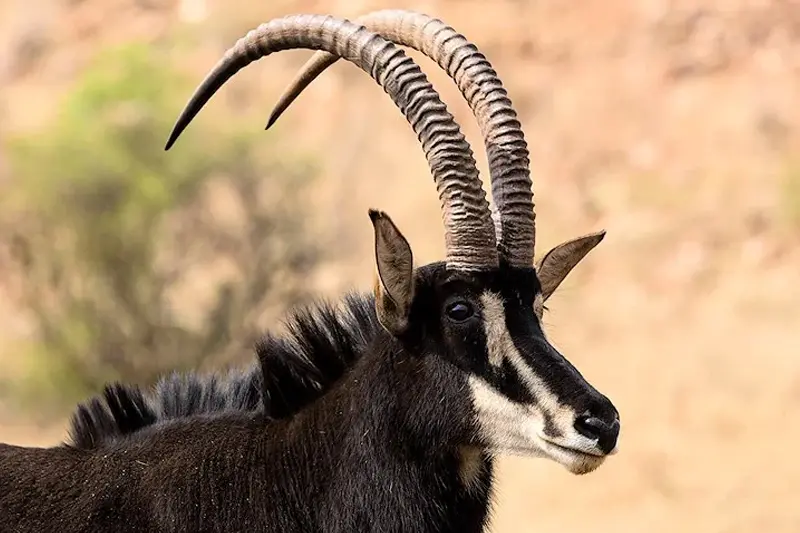
The sable antelope (Hippotragus niger) is a large, robust antelope that stands approximately 1.3-1.4 metres at the shoulder, with mature bulls weighing between 220 and 270 kg. The species is strongly sexually dimorphic: bulls develop a rich, dark chocolate-brown to jet-black coat as they mature, while cows and younger animals are a lighter chestnut-brown. Both sexes carry the sable’s iconic backward-curving horns, though the bull’s are significantly longer, heavier, and more dramatically curved. The face is marked with bold white and black patterns that make the sable one of the most photogenic animals in Africa.
Sable are predominantly grazers, feeding on medium-height grasses in open woodland and savanna. They are closely associated with miombo and mixed bushveld habitats where grass is plentiful and there is adequate tree cover for shade and protection. Sable are herd animals, typically found in groups of 10-30 individuals led by a dominant cow, with territorial bulls defending their home ranges against rivals. Mature bulls can be solitary or may be found on the periphery of female herds, particularly during the breeding season.
The sable’s temperament is notably aggressive for an antelope. Cornered or wounded sable bulls have been known to charge with lethal intent, and their sweeping horns are formidable weapons capable of inflicting fatal injuries on predators — and hunters. Lions, leopards, and African wild dogs all prey on sable, but attacks on healthy adult bulls are rare, testament to the animal’s size, strength, and willingness to fight.
Sable belong to the tribe Hippotragini — the horse antelopes — alongside the roan antelope, gemsbok, and oryx. Within this group, the sable holds the highest trophy status in South Africa, combining dramatic visual appeal with genuine hunting difficulty and strictly limited annual availability. Their combination of large body mass, formidable curved horns, and herd vigilance makes sable one of the most challenging and rewarding animals to pursue on the African continent.
Sable are large-bodied animals: bulls weigh 200–270 kg and stand 130–140 cm at the shoulder, placing them firmly in the heavyweight category of South African plains game. Cows are noticeably smaller and carry a dark chestnut-brown coat — a stark contrast to the mature bull’s jet-black. This colour difference, together with the female’s shorter, more upright horns, is the primary field identification tool in mixed herds. Correctly identifying a mature bull before shooting is essential; cows and young bulls are strictly protected under Gaspare Spanio Safaris’ herd management programme.
Sable bulls reach full trophy maturity at six to ten years of age. The progression is marked by a gradual darkening from chestnut-brown (young males) through dark brown to jet-black, with the horn curvature increasing and sweeping further back over the shoulders with each passing year. The longest horns — often 45 to 55 inches on prime Limpopo bulls — are typically found on animals eight years and older. Professional hunters assess coat colour (fully black indicates maturity), horn curvature, and overall body mass before presenting a specific bull to the client.
Sable require large areas of mixed bushveld with open savanna grasslands for grazing, combined with reliable access to permanent water. Their distribution on the Limpopo Plateau is confined to areas of suitable habitat and privately managed game reserves where breeding herds are actively supervised. Because sable populations on private reserves are carefully controlled units, the annual trophy offtake is strictly limited. Most reputable Limpopo outfitters clear only one to three mature bulls per property per year — the primary driver of the significant premium on sable trophy fees relative to other plains game.
How to Hunt Sable Antelope in South Africa
Rifle Hunting
Rifle hunting for sable antelope demands a caliber that delivers reliable knockdown power on a large, heavy-boned animal. The .30-06 Springfield loaded with premium 180-grain bullets represents the minimum acceptable caliber, while the .300 Winchester Magnum is considered ideal by most professional hunters. For the hunter who wants absolute certainty, the .338 Winchester Magnum provides an additional margin of performance. Use only premium controlled-expansion bullets — the Barnes TSX, Nosler Partition, or Swift A-Frame are all excellent choices. Shot distances typically range from 100 to 250 metres, depending on the terrain and the approach.
Hunting sable on foot involves locating a herd or territorial bull, then conducting a careful stalk using the broken woodland terrain for concealment. Sable are alert but not as nervous as species like eland or kudu, and a well-planned approach through bushveld with adequate cover can bring a hunter within comfortable rifle range. The critical moment is identifying the right bull — in a herd situation, multiple animals with horns will be present, and distinguishing a mature trophy bull from younger animals or cows requires experience and patience.
Bow Hunting
Bow hunting sable is a realistic proposition for the skilled archer willing to invest the time. A compound bow with a minimum draw weight of 70 pounds and heavy, razor-sharp fixed-blade broadheads is essential. The sable’s thick hide and heavy musculature demand maximum penetration. Waterhole blinds are the most effective method, allowing shots at 20-35 metres. Because sable are herd animals that visit water regularly, a well-positioned blind on an active waterhole can produce an opportunity within a day or two. The challenge lies in selecting the right animal from the group and waiting for a perfect broadside or slightly quartering-away presentation.
Spot and Stalk
Spot-and-stalk hunting for sable involves glassing open woodland areas from elevated positions — koppies, termite mounds, or vehicle observation — to locate a herd or solitary bull, then closing the distance on foot. The mixed bushveld of Limpopo provides reasonable stalking cover in the form of scattered trees, shrubs, and undulating terrain. The stalk must be conducted with careful attention to wind direction and noise discipline, but sable are generally less skittish than kudu or eland, and a patient, well-executed approach has a good chance of success. The final 100 metres of the stalk are the most critical, as this is where the hunter must confirm trophy quality, select the right bull, and find a clear shooting lane through the bush.

Where to Hunt
Sable antelope are found across a band of sub-Saharan Africa stretching from Kenya to South Africa, but the finest trophy hunting is concentrated in southern Africa. South Africa’s Limpopo Province is a premier destination for sable hunting, with well-managed private properties producing consistently outstanding trophies. Gaspare Spanio Safaris offers sable antelope hunting on their 3,000-hectare private game farm in Limpopo, where dedicated management practices have built a healthy population of high-quality sable. The property’s mixed bushveld habitat — with its combination of open grassland, scattered woodland, and permanent water — mirrors the sable’s preferred environment perfectly.
The advantage of hunting sable on a private conservancy is the ability to manage the population for trophy quality. Bull-to-cow ratios, age structures, and genetic diversity are carefully monitored to ensure that visiting hunters have the opportunity to take genuinely exceptional trophies.
Best Time to Hunt
The best time for sable antelope hunting South Africa is during the dry winter months from May through September. The reduced vegetation makes it easier to spot sable herds in the open woodland, and animals concentrate around permanent water sources, increasing encounter rates. June through August is particularly productive, as the dry conditions and cool temperatures create ideal hunting conditions.
The breeding season runs from May to July, during which territorial bulls are more active and visible as they patrol their home ranges and interact with female herds. This period can produce exceptional hunting opportunities as bulls are less cautious than usual. The late winter months of August and September offer excellent visibility and predictable animal movements, though the landscape can be dusty and the bush very dry.
What Is a Trophy Sable? — Rowland Ward & SCI Standards
Sable antelope trophies are measured by horn length, following the curve from base to tip. The minimum entry scores for the major record books are:
- SCI (Safari Club International) minimum: 100 inches
- Rowland Ward minimum: 40 inches
- Rowland Ward world record: 63⅜ inches — taken in Zimbabwe
- SCI world record: 216 points
A truly exceptional sable bull will measure 43 inches or more on Rowland Ward, with thick, heavily ridged bases and deeply curved horns that sweep well back past the shoulders. When judging a sable in the field, look for horns that extend well beyond the rump line when viewed from the side, heavy bases, and a jet-black body colour. The darker the coat, the more mature the bull — young bulls and cows are brown rather than black. Sable is classified as a premium trophy animal, and the trophy fee reflects this status.
⚠️ Limited availability: Sable is offered on a strictly limited basis — only a small number of mature bulls are cleared for harvest each season to protect the breeding population. We recommend booking well in advance to secure your preferred dates. Current sable trophy fees are listed on our South Africa Trophy Price List.
Sable Shot Placement — Heart-Lung Zone
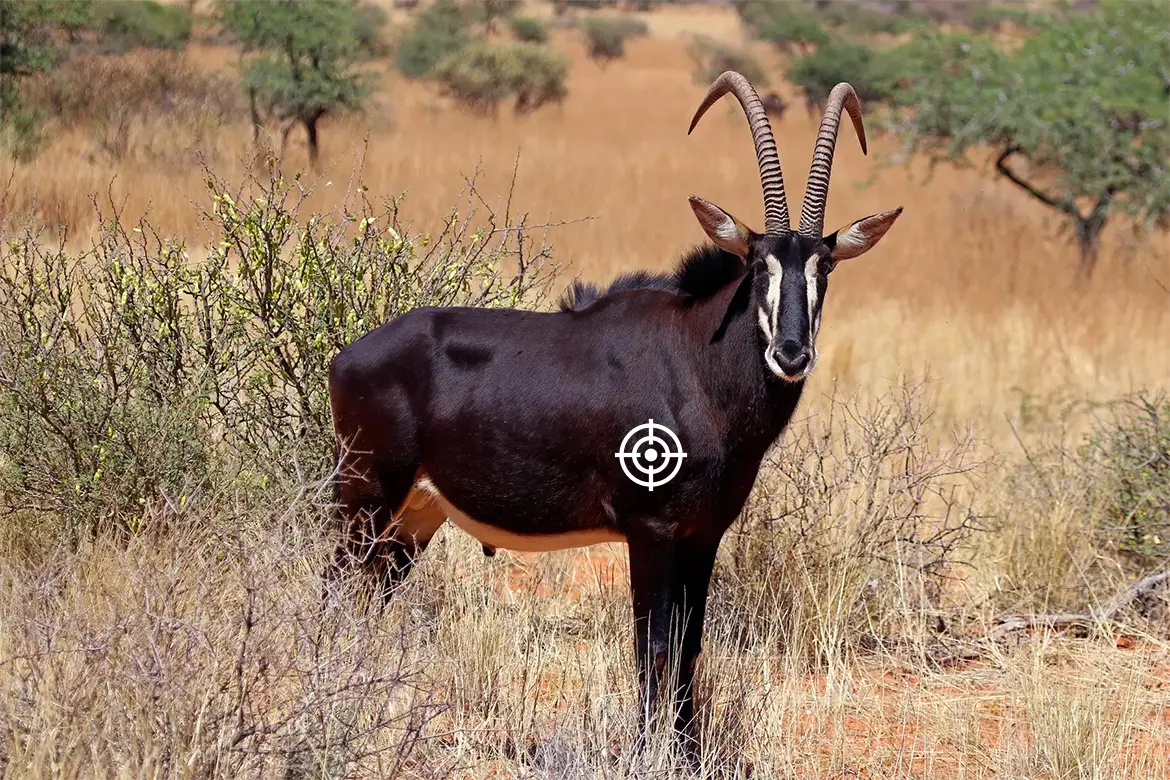
Shot placement on sable must be deliberate and precise. For a visual overview across all species, see our South Africa Shot Placement Guide. The ideal broadside shot is placed directly behind the front shoulder, one-third of the way up from the bottom of the chest. This targets the heart-lung area and produces the most reliable, ethical kill. The sable’s heavy shoulder bone can deflect lighter bullets, so if you are shooting a caliber at the lower end of the recommended range, aim slightly behind the shoulder rather than through it to ensure the bullet reaches the vitals without encountering heavy bone.

On a quartering-away shot, aim for the opposite front leg, placing the bullet so it passes through the chest cavity at an angle and exits through or near the far shoulder. Avoid quartering-towards shots unless you are using a heavy caliber with a tough, bonded bullet capable of penetrating through the shoulder joint. High shoulder shots can be instantly effective but require precise placement and a rifle with sufficient energy to shatter the heavy scapula. When in doubt, a conservative heart-lung shot is always the best choice.
Remember that a wounded sable bull can be dangerous — always be prepared for a follow-up shot and approach downed animals with extreme caution.
Recommended Calibers for Sable Antelope Hunting
Sable are large, powerful animals weighing up to 270 kg with dense bone structure across the shoulder and neck. A minimum of .308 Winchester (7.62×51mm) is the practical floor for sable, though most professional hunters recommend stepping up to heavier cartridges for the additional penetration they provide on quartering shots.
- .308 Winchester: Minimum recommended caliber. Use premium bonded bullets of 165–180 grain. Effective on clean broadside shots at sensible ranges, but leaves little margin on angled presentations through heavy shoulder bone.
- .30-06 Springfield: A reliable step up in energy and bullet weight range. A 180-grain Federal Trophy Bonded or Nosler Partition is the standard selection for sable-class animals in South Africa.
- .300 Winchester Magnum: The preferred choice for most professional hunters guiding sable. Superior retained energy and penetration on quartering shots, with additional velocity providing a useful margin at longer distances across open Limpopo savanna. 180-grain controlled-expansion bullets are ideal.
- 9.3×62 Mauser: A traditional European cartridge that combines excellent sectional density with moderate recoil. Well-respected in South Africa as an all-conditions plains game and dangerous game caliber, and particularly popular among German and Scandinavian hunters. Its deep-penetration characteristics suit sable hunting well.
Sable are not classified as dangerous game in the strict sense, but wounded bulls have been known to turn on both hounds and hunters — the horns are a genuine weapon. Shot placement on the vital zone on the first shot is more important than any caliber selection. Premium bonded or controlled-expansion bullets are mandatory. Federal Trophy Bonded, Swift A-Frame, Barnes TSX, and Nosler Partition are all proven performers on sable.
Frequently Asked Questions
Why is the sable trophy fee so high compared to other plains game?
The sable antelope is classified as a premium trophy species due to its rarity, the difficulty of producing and maintaining quality breeding populations, and its status as one of Africa’s most sought-after trophies. Managing sable on a private property requires significant investment in habitat, genetics, and population management. The trophy fee reflects this investment and the exceptional quality of the hunting experience.
How do I distinguish a trophy bull from a cow in the field?
Mature sable bulls are jet-black in colour, while cows and young bulls are chestnut-brown to dark brown. Bulls are also noticeably larger and heavier in build, with thicker, longer horns that curve more dramatically. Your professional hunter will help you identify and evaluate bulls before the shot — never rush this process, as shooting an immature animal or a cow would be a significant waste of a premium trophy opportunity.
How many days should I plan for a sable hunt?
Allow a minimum of 5-7 hunting days specifically for sable. While it is possible to encounter and harvest a bull on the first day, the selective nature of sable hunting — finding not just any bull, but a mature trophy-quality animal — often requires patience. Most hunters combine sable with other species on a 7–10 day safari to make the most of their time. Browse our hunting packages for pre-built combination options.
What is the best caliber for sable antelope?
The .300 Winchester Magnum is considered the ideal all-round choice for sable antelope hunting South Africa. It provides flat trajectory, manageable recoil, and sufficient energy for a clean kill on these large, heavy-boned animals. The .30-06 with premium 180-grain bullets is acceptable but represents the minimum. For the hunter who values maximum stopping power, the .338 Winchester Magnum is an excellent option.
Are sable dangerous when wounded?
Yes. A wounded sable bull is one of the most dangerous antelope in Africa. Their sweeping horns are razor-sharp and they will not hesitate to charge when cornered or in pain. This is one of several reasons why correct caliber selection and precise shot placement are so important when hunting sable. Always follow up wounded animals cautiously and with your rifle loaded and ready.
The sable antelope is Africa’s crowning glory among plains game — a trophy that will command attention in any collection and memories that will last a lifetime. Contact Gaspare Spanio Safaris to discuss your sable antelope hunting South Africa safari. Sable availability is strictly limited — reach out early to secure your dates.
Where does sable rank among South African trophy animals?
Among trophy hunters, sable consistently rank in the top tier of South African plains game — cited alongside kudu and nyala for the combination of visual impact, hunting challenge, and trophy quality they represent. The dramatic scimitar horns, which can exceed 50 inches on exceptional Limpopo bulls, produce a wall mount of immediate visual impact. Many hunters who have completed a classic seven-species Limpopo safari cite the sable bull as the single most impressive trophy they pursued. The rarity of mature bulls, the strictly limited annual offtake, and the management investment required to produce trophy-quality animals add an exclusivity to the sable trophy that few other plains game species can match. Hunters who take a sable alongside buffalo, kudu, and nyala on a single Limpopo safari have assembled one of the most prestigious collections available anywhere in Africa.

